로미오와 줄리엣 학습자료 - AP English, SAT Reading, 셰익스피어 비극 대비
영어 원문을 근거로 AP English Literature, SAT Reading, IB English, 미국식 문학 에세이까지 연결하는 실전 학습 가이드입니다.
이 학습자료는 미국식 문학 수업과 영어 에세이 작성을 목표로 합니다. 작품 전체 흐름을 먼저 잡고 싶다면 본문 해설을 먼저 읽어도 좋습니다.
이 자료의 목표
한국어로 설명하지만, 시험에서 자주 쓰는 용어와 원문 근거는 영어로 익히는 방식입니다. Romeo and Juliet은 줄거리를 이미 아는 학생이 많아서, AP English Literature와 SAT Reading에서는 "무슨 일이 일어났는가"보다 언어가 사랑, 이름, 운명, 폭력을 어떻게 만든다는가를 묻는 경우가 많습니다.
이 자료는 다음 능력을 연습합니다.
- prologue, sonnet, oxymoron, dramatic irony를 실제 장면과 연결하기
- Romeo, Juliet, Mercutio, Tybalt, Friar Lawrence의 기능을 에세이 문장으로 바꾸기
- 짧은 셰익스피어 원문을 근거로 close reading 하기
- SAT Reading 스타일의 추론, 기능, 어휘, 톤 문제 풀기
- AP Lit 스타일 thesis와 paragraph 방향 만들기
1. Quick Review
- Original title: The Tragedy of Romeo and Juliet
- Author: William Shakespeare
- First printed: 1597
- Main setting: Verona; briefly Mantua
- Genre: tragedy, early modern drama
- Central conflict: two young lovers try to create a private bond inside a public feud
- Core themes: love and hate, names and identity, fate and choice, youth and speed, masculine honor, failed adult mediation
- Common exam angles: prologue and fate, balcony scene, sonnet form, Mercutio's curse, Friar Lawrence's warning, dramatic irony in the final act
한 문장 요약은 이렇게 정리할 수 있습니다.
Romeo and Juliet fall in love across a family feud, and their private marriage is destroyed by public violence, secrecy, and failed communication.
2. 시험용 줄거리 구조
Exposition
베로나의 몬터규와 캐퓰렛 가문은 거리 싸움을 반복합니다. 영주는 다시 싸우면 사형이라고 경고하고, 로미오는 처음에는 로잘린 때문에 우울해합니다.
Rising Action
로미오는 캐퓰렛 파티에서 줄리엣을 만나고, 두 사람은 서로의 가문 이름을 알기 전에 사랑에 빠집니다. 발코니 장면과 비밀 결혼은 사랑을 개인적 선택으로 만들지만, 동시에 비밀 때문에 사회적 오해가 커집니다.
Turning Point
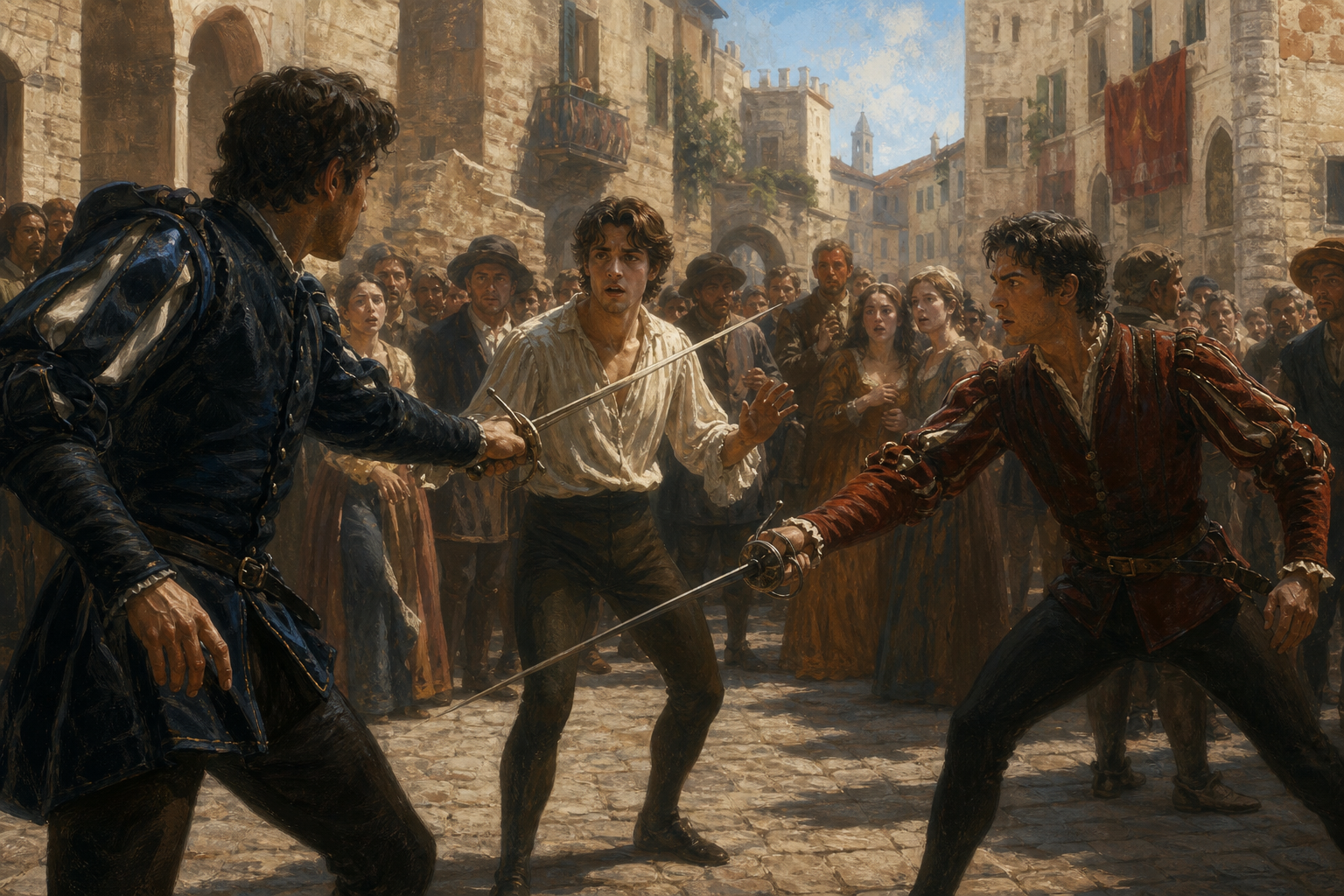
티볼트가 로미오에게 결투를 요구합니다. 로미오는 새 친족인 티볼트와 싸우지 않으려 하지만 머큐시오가 대신 나서고 죽습니다. 로미오는 티볼트를 죽이고 추방됩니다.
Crisis
캐퓰렛은 줄리엣에게 파리스와 결혼하라고 압박합니다. 줄리엣은 로런스의 수면제 계획을 선택하고, 로런스는 로미오에게 설명 편지를 보내려 합니다.
Resolution
편지는 로미오에게 도착하지 못합니다. 로미오는 줄리엣이 죽었다고 믿고 독약을 마시며, 줄리엣은 깨어난 뒤 로미오의 죽음을 보고 스스로 죽습니다. 두 가문은 너무 늦게 화해합니다.
3. 핵심 원문 구절 읽기
아래 Passage들은 외울 문장 목록이 아니라 close reading 연습용입니다. 각 구절은 장면 맥락, 단어 선택, 문장 구조, 주제 연결을 함께 봐야 합니다.
Passage 1: star-crossed lovers
A pair of star-cross'd lovers take their life.
맥락: 프롤로그가 결말을 미리 말하며 관객의 시선을 운명과 구조로 이동시킵니다.
읽는 법: star-cross'd는 사랑이 개인 감정보다 큰 우주적, 사회적 힘과 충돌한다는 인상을 줍니다. take their life는 스스로 죽는다는 의미와 생명을 빼앗긴다는 감각을 동시에 만듭니다.
Essay use: Use it to discuss fate, dramatic irony, and how the prologue turns suspense into moral attention.
Passage 2: civil blood
Where civil blood makes civil hands unclean.
맥락: 프롤로그는 베로나의 싸움을 사적인 원한이 아니라 시민 공동체의 오염으로 제시합니다.
읽는 법: civil의 반복은 시민 질서와 시민 폭력을 동시에 드러냅니다. 같은 단어가 두 번 쓰이면서 도시가 스스로를 더럽히는 모순이 강조됩니다.
Essay use: Use it for essays about public violence, feud culture, and collective responsibility.
Passage 3: my only love
My only love sprung from my only hate!
맥락: 줄리엣은 로미오가 몬터규라는 사실을 알게 됩니다.
읽는 법: only love와 only hate의 대칭은 감정과 사회적 정체성이 충돌하는 순간을 압축합니다. 느낌표는 깨달음이 단순 정보가 아니라 충격이라는 점을 보여 줍니다.
Essay use: Use it to discuss the collision between private desire and inherited identity.
Passage 4: what's in a name
What's in a name? That which we call a rose by any other name would smell as sweet.
맥락: 발코니 장면에서 줄리엣은 로미오라는 사람과 몬터규라는 이름을 분리하려 합니다.
읽는 법: 질문과 비유가 결합되어 있습니다. 장미의 향기는 본질을 뜻하지만, 작품 전체는 이름이 실제로 사람을 위험하게 할 만큼 강하다는 반론을 보여 줍니다.
Essay use: Use it for names, identity, social labels, and Juliet's intellectual maturity.
Passage 5: violent delights
These violent delights have violent ends.
맥락: 프라이어 로런스는 결혼 직전 두 사람에게 급하고 격렬한 기쁨의 위험을 경고합니다.
읽는 법: violent의 반복은 사랑의 강도와 베로나의 폭력을 연결합니다. 이 문장은 사랑을 부정하지 않지만, 사랑이 놓인 사회적 조건을 불안하게 만듭니다.
Essay use: Use it to connect love, speed, foreshadowing, and tragic structure.
Passage 6: a plague
A plague o' both your houses!
맥락: 머큐시오는 티볼트와의 결투에서 치명상을 입은 뒤 양쪽 가문을 저주합니다.
읽는 법: both가 핵심입니다. 머큐시오는 한쪽 편만 비난하지 않고, 양가의 증오가 자신을 희생시켰다고 봅니다. 희극적 언어의 인물이 비극의 도덕적 판결자가 됩니다.
Essay use: Use it for feud responsibility, tonal shift, and Mercutio's dramatic function.
Passage 7: never was a story
For never was a story of more woe than this of Juliet and her Romeo.
맥락: 마지막 장면에서 영주는 죽음 이후의 화해를 선언하며 비극을 정리합니다.
읽는 법: Juliet and her Romeo라는 순서는 익숙한 제목을 뒤집습니다. 결말은 사랑을 기념하지만, woe는 그 기념이 애도 위에 세워졌음을 강조합니다.
Essay use: Use it for ending interpretation, public mourning, and the cost of delayed reconciliation.
4. Close Reading: 이름, 속도, 운명
Romeo and Juliet close reading에서 가장 흔한 실수는 "운명 때문에 죽었다" 또는 "너무 충동적이었다"에서 멈추는 것입니다. 더 좋은 답안은 운명, 언어, 사회 구조, 인물 선택이 어떻게 함께 작동하는지 설명합니다.
1단계: 장면의 공개성부터 확인하기
거리, 파티, 발코니, 수도사의 방, 묘지는 각각 다른 사회적 압력을 만듭니다. 공적인 거리에서는 명예와 폭력이, 사적인 발코니에서는 이름과 자기 선택이, 묘지에서는 모든 비밀의 결과가 드러납니다.
2단계: 반복되는 반대어를 표시하기
love/hate, light/dark, haste/delay, name/body, death/life 같은 쌍을 표시하세요. 셰익스피어는 단어의 대립을 통해 인물의 감정이 분열된 세계에서 움직인다는 사실을 보여 줍니다.
3단계: dramatic irony를 설명하기
관객은 줄리엣이 실제로 죽지 않았음을 알지만 로미오는 모릅니다. 이 차이는 단순한 긴장감이 아니라, 정보 전달 실패가 어떻게 비극을 만드는지 보여 주는 장치입니다.
Worked example: What's in a name?
Literal situation: 줄리엣은 로미오가 듣고 있는 줄 모른 채, 몬터규라는 이름이 왜 사랑을 막아야 하는지 묻습니다.
Evidence: name, rose, smell as sweet.
Device: rhetorical question, metaphor, contrast between essence and social label.
Meaning: 줄리엣은 사람의 본질이 가문 이름보다 중요하다고 주장하지만, 작품은 바로 그 이름이 베로나에서 생사를 결정하는 사회적 힘임을 보여 줍니다.
Essay sentence: Shakespeare uses Juliet's rose metaphor to imagine identity beyond inherited names, while the tragedy shows how violently those names still govern public life.
답안을 쓸 때는 이 문장을 "이름은 중요하다"로만 처리하지 말고, 두 층을 함께 설명하세요. 첫째, 줄리엣의 말은 개인의 본질이 가문 이름보다 앞선다는 윤리적 주장입니다. 둘째, 작품의 사건은 그 주장이 왜 실현되기 어려운지 보여 줍니다. 베로나에서는 이름이 호칭이 아니라 결투, 추방, 결혼 압박, 죽음을 움직이는 사회적 신호이기 때문입니다. 좋은 close reading은 줄리엣의 이상과 베로나의 현실을 한 문장 안에서 충돌시킵니다.
5. Literary Devices: 바로 쓰는 장치 10개
문학 장치를 쓸 때는 장치 이름만 나열하면 점수가 오르지 않습니다. metaphor, dramatic irony, foreshadowing 같은 용어는 evidence와 commentary 사이를 연결할 때 의미가 있습니다. 아래 항목들은 "장치가 있다"가 아니라 "그 장치가 독자의 판단을 어떻게 바꾸는가"까지 쓰는 연습용입니다.
1. Prologue
프롤로그는 결말을 먼저 알려 줍니다. 그래서 관객은 "무슨 일이 일어날까"보다 "왜 막지 못했을까"를 보게 됩니다.
2. Dramatic Irony
줄리엣의 수면제 계획과 로미오의 오해는 관객이 더 많이 알고 인물이 덜 아는 구조입니다. 비극의 고통은 정보의 격차에서 커집니다.
3. Sonnet Form
첫 만남의 대화는 소네트처럼 맞물립니다. 두 사람이 같은 언어 리듬을 공유한다는 점이 사랑의 설득력을 만듭니다.
4. Oxymoron
로미오는 loving hate, heavy lightness 같은 모순어법을 사용합니다. 사랑과 증오가 같은 세계에 붙어 있다는 작품의 논리를 미리 보여 줍니다.
5. Light and Dark Imagery
줄리엣은 어둠 속의 빛으로 묘사되고, 밤은 둘의 사랑을 보호하지만 동시에 비밀을 만듭니다.
6. Foil
벤볼리오는 평화, 티볼트는 폭력, 머큐시오는 재치와 공격성을 보여 주며 로미오의 선택을 비춥니다.
7. Pun and Wordplay
초반 하인들의 말장난과 머큐시오의 농담은 웃음을 주지만, 말이 얼마나 빨리 폭력으로 변하는지도 보여 줍니다.
8. Foreshadowing
프롤로그, 로런스의 경고, 줄리엣의 불길한 상상은 결말을 예고합니다.
9. Symbolic Setting
거리, 발코니, 수도사의 방, 무덤은 각각 공적 폭력, 사적 사랑, 중재, 실패한 화해를 상징합니다.
10. Reversal
결혼은 평화를 만들 수 있는 사건처럼 보이지만, 비밀 때문에 오히려 결투 장면에서 오해를 키웁니다.
에세이에서는 한 단락에 장치를 너무 많이 넣기보다, 한 장치를 충분히 설명하는 편이 좋습니다. 예를 들어 dramatic irony를 고른다면 "관객은 줄리엣이 살아 있음을 알고 로미오는 모른다"에서 멈추지 말고, 그 정보 격차가 왜 로미오의 선택을 더 고통스럽고 더 비판 가능하게 만드는지까지 이어 가야 합니다. 장치의 이름은 출발점이고, 분석은 그 장치가 theme와 character judgment를 어떻게 바꾸는지 보여 주는 부분입니다.
6. 인물 분석을 영어 답안으로 바꾸기
Romeo
lover shaped by speed and public violence
Essay sentence: Romeo's tragedy lies in the gap between his desire for private love and the public masculine code that pulls him back into revenge.
Juliet
young woman who thinks beyond inherited names
Essay sentence: Juliet's language about names shows intellectual maturity, but her limited social power forces that insight into secrecy rather than open change.
Mercutio
comic energy turned tragic witness
Essay sentence: Mercutio's death changes witty masculine competition into irreversible tragedy and exposes both houses as morally responsible.
Tybalt
honor culture in its purest form
Essay sentence: Tybalt embodies a feud culture where peace sounds like weakness and identity is defended through violence.
Friar Lawrence
adult mediator whose plan depends on fragile timing
Essay sentence: Friar Lawrence's good intentions reveal the danger of solving public hatred through secret private schemes.
7. 주제별 Thesis 만들기
Names
Identity
Weak: Names are important.
Strong: Shakespeare makes inherited names socially powerful enough to endanger bodies, even as Juliet imagines a love beyond those labels.
Fate
Choice and Structure
Weak: Fate kills the lovers.
Strong: The play frames the lovers as star-crossed while showing that human choices, feud culture, and failed communication make fate visible.
Violence
Public Feud
Weak: The families fight too much.
Strong: Verona's feud turns private identity into public violence, making even love depend on secrecy, speed, and risk.
Youth
Speed
Weak: Romeo and Juliet are impulsive.
Strong: The lovers' haste becomes tragic because it develops inside a society that also acts with dangerous speed: duels, commands, threats, and forced marriage.
8. SAT Reading Sample
아래 문제는 공식 College Board 문제가 아니라, 작품 원문과 시험 유형을 바탕으로 만든 SAT Reading 스타일 연습문제입니다. 질문, 보기, Answer: X. 표기는 영어로 두고, 해설은 한국어로 정리했습니다.
Question 1
The prologue's phrase "star-cross'd lovers" primarily suggests that the lovers are:
- A. guided by ordinary family advice
- B. opposed by forces larger than private feeling
- C. uninterested in public reputation
- D. protected by Verona's laws
Answer: B. star-cross'd는 두 사람의 사랑이 개인 감정만으로 해결되지 않는 더 큰 힘과 충돌한다는 뜻입니다. 가족 조언이나 법의 보호가 아니라 운명, 사회 구조, 가문 갈등의 압력이 핵심입니다.
Question 2
In the prologue, the repetition of "civil" emphasizes:
- A. the city's own society becoming violent
- B. Romeo's private sadness
- C. Juliet's obedience to her mother
- D. Friar Lawrence's religious training
Answer: A. civil blood와 civil hands는 시민 질서 안에서 시민의 피가 흐른다는 모순을 만듭니다. 개인 연애나 종교 교육보다 베로나 공동체 전체의 오염을 보여 줍니다.
Question 3
Romeo's shift from Rosaline to Juliet most strongly reveals:
- A. his complete emotional stability
- B. his rejection of all poetic language
- C. the speed and intensity of his desire
- D. his legal authority over the feud
Answer: C. 로미오는 로잘린에게서 줄리엣으로 매우 빠르게 이동합니다. 이 속도는 진짜 감정이 없다는 뜻이 아니라, 그의 사랑이 얼마나 강하고 빠르게 언어와 행동을 바꾸는지 보여 줍니다.
Question 4
The lovers' first shared dialogue is important because it:
- A. proves their families approve
- B. removes all danger from the plot
- C. explains the Prince's law
- D. forms a shared poetic pattern
Answer: D. 첫 대화는 소네트처럼 맞물리며 두 사람이 같은 리듬과 이미지를 공유한다는 점을 보여 줍니다. 가족 승인이나 법적 해결은 이 장면에 없습니다.
Question 5
Juliet's "rose" comparison argues that:
- A. family names define moral worth completely
- B. Romeo should become Prince of Verona
- C. outward labels do not change inner reality
- D. flowers control the plot
Answer: C. 줄리엣은 장미의 이름이 바뀌어도 향기는 같다고 말하며 이름과 본질을 분리하려 합니다. 하지만 작품 전체는 그 이름이 사회적으로 얼마나 위험한 힘인지도 함께 보여 줍니다.
Question 6
Friar Lawrence's warning about "violent delights" functions mainly as:
- A. comic relief
- B. foreshadowing
- C. a business contract
- D. a public law
Answer: B. 로런스의 경고는 두 사람의 급하고 강한 사랑이 폭력적 결말과 연결될 수 있음을 미리 암시합니다. 웃음이나 계약, 법률 조항으로 읽기는 어렵습니다.
Question 7
Tybalt's reaction to Romeo at the feast shows that he:
- A. treats peace as higher than honor
- B. ignores family identity
- C. wants Juliet to choose freely
- D. reads Romeo's presence as an insult
Answer: D. 티볼트는 로미오가 파티에 온 것을 가문 명예에 대한 모욕으로 받아들입니다. 그의 사고방식은 평화보다 체면과 충돌에 가깝습니다.
Question 8
Mercutio's curse, "A plague o' both your houses," assigns blame to:
- A. only Romeo
- B. only Juliet
- C. both feuding families
- D. the Nurse's household
Answer: C. both가 답의 근거입니다. 머큐시오는 어느 한쪽이 아니라 두 가문의 오래된 싸움이 자신을 죽음으로 몰았다고 저주합니다.
Question 9
Romeo's refusal to fight Tybalt becomes misunderstood because:
- A. Romeo secretly knows Tybalt is now connected to him by marriage
- B. Benvolio has banned all language
- C. Juliet has publicly announced the marriage
- D. the Prince has pardoned Tybalt
Answer: A. 로미오는 비밀 결혼 때문에 티볼트를 친족처럼 여기지만, 다른 사람들은 그 사실을 모릅니다. 그래서 평화 시도는 비겁함처럼 오해됩니다.
Question 10
The morning-after scene with the lark and nightingale dramatizes:
- A. the lovers' wish to delay separation
- B. the end of all family pressure
- C. a simple lesson about birds
- D. Mercutio's return
Answer: A. 종달새와 나이팅게일을 둘러싼 대화는 밤이 더 지속되기를 바라는 마음과 아침이 오면 헤어져야 한다는 현실을 보여 줍니다.
Question 11
Capulet's later treatment of Juliet reveals:
- A. Juliet's full political power
- B. Romeo's control of the Capulet house
- C. paternal authority turning coercive
- D. Mercutio's legal plan
Answer: C. 캐퓰렛은 딸의 동의보다 결혼 명령을 앞세우며 언어적으로 폭력적이 됩니다. 이는 보호자 권위가 강압으로 변하는 장면입니다.
Question 12
The Nurse's advice to marry Paris is painful to Juliet because it:
- A. confirms Romeo is legally present
- B. abandons Juliet's private commitment for social safety
- C. reveals that Paris is a Montague
- D. solves the conflict honestly
Answer: B. 간호사는 현실적 안전을 택하지만, 줄리엣에게는 로미오와의 결혼 약속을 버리라는 말로 들립니다. 진실한 해결이나 로미오의 귀환이 아닙니다.
Question 13
Friar Lawrence's potion plan is risky mainly because it depends on:
- A. Tybalt forgiving Mercutio
- B. the Prince reading poetry
- C. Rosaline joining the Capulets
- D. perfect timing and successful communication
Answer: D. 계획은 줄리엣의 수면, 장례, 편지 전달, 로미오의 귀환이 모두 맞아야 합니다. 한 연결이 끊어지자 비극이 발생합니다.
Question 14
The failed letter to Romeo is an example of:
- A. a successful public trial
- B. dramatic irony and broken communication
- C. comic misunderstanding without consequence
- D. Juliet's lack of courage
Answer: B. 관객은 계획을 알지만 로미오는 모릅니다. 이 정보 격차와 전달 실패가 마지막 비극을 직접 만듭니다.
Question 15
Paris's death in the tomb scene complicates the ending because it shows:
- A. Paris controls the feud
- B. Juliet never mattered to anyone
- C. the tragedy harms more than the central lovers
- D. the apothecary is the hero
Answer: C. 파리스의 죽음은 비극이 로미오와 줄리엣만의 문제가 아니라 주변 인물까지 휩쓸었다는 점을 보여 줍니다.
Question 16
The final line "Juliet and her Romeo" is notable because it:
- A. removes Juliet from the tragedy
- B. praises Tybalt as ruler
- C. denies that sorrow exists
- D. reverses the usual title order
Answer: D. 제목과 달리 줄리엣이 먼저 나오며, 결말의 애도 속에서 두 사람의 관계를 새롭게 배열합니다. 슬픔을 부정하는 문장이 아닙니다.
Question 17
The play's repeated light imagery most often presents Juliet as:
- A. a legal judge
- B. a figure Romeo sees as transforming darkness
- C. a military commander
- D. a symbol of old age
Answer: B. 로미오는 줄리엣을 횃불, 태양, 빛의 이미지로 말합니다. 이 이미지는 그의 사랑이 어둠 속에서 의미를 찾는 방식과 연결됩니다.
Question 18
Benvolio functions in the play mainly as:
- A. the cause of Juliet's potion
- B. the ruler of Mantua
- C. Romeo's enemy
- D. a peace-seeking foil to more aggressive men
Answer: D. 벤볼리오는 싸움을 말리고 상황을 설명하는 인물입니다. 티볼트나 머큐시오와 대비되어 평화적 태도를 보여 줍니다.
Question 19
The play's treatment of fate is best described as:
- A. fate alone acts while humans do nothing
- B. fate language works together with human choices and social systems
- C. fate is mentioned only in the final line
- D. fate protects the lovers from error
Answer: B. 프롤로그는 운명을 말하지만, 실제 장면들은 결투, 강제 결혼, 비밀, 편지 실패 같은 인간적 선택과 사회 구조를 함께 보여 줍니다.
Question 20
The reconciliation of the families is bitter because:
- A. prevents all mourning
- B. happens before Romeo meets Juliet
- C. comes only after irreversible loss
- D. proves the feud was harmless
Answer: C. 화해는 이루어지지만 너무 늦습니다. 작품의 씁쓸함은 젊은 두 사람이 죽은 뒤에야 어른들이 증오의 대가를 인정한다는 점에 있습니다.
9. AP Lit Essay Questions
아래 문항은 구체적 장면을 thesis, outline, textual evidence, commentary로 바꾸는 AP Lit 스타일 연습 질문입니다.
Essay Question 1
프롤로그는 결말을 미리 알려 주면서도 극의 긴장을 없애지 않습니다. 셰익스피어가 프롤로그를 사용해 관객의 관심을 운명, 책임, 사회 구조로 이동시키는 방식을 분석하세요.
Essay Question 2
베로나의 첫 거리 싸움은 단순한 배경 설명이 아닙니다. 이 장면이 공적 질서, 남성 명예, 가문 폭력을 어떻게 소개하는지 분석하세요.
Essay Question 3
로미오의 로잘린 사랑과 줄리엣 사랑을 비교하세요. 언어, 속도, 자기연민, 상호성의 차이를 중심으로 설명하세요.
Essay Question 4
로미오와 줄리엣의 첫 대화는 종교 이미지와 소네트 구조를 사용합니다. 이 형식이 두 사람의 즉각적 연결을 어떻게 설득력 있게 만드는지 분석하세요.
Essay Question 5
발코니 장면에서 줄리엣은 이름과 본질의 관계를 질문합니다. 이 장면이 사랑의 낭만성과 사회적 위험을 동시에 보여 주는 방식을 설명하세요.
Essay Question 6
프라이어 로런스는 평화를 바라지만 위험한 계획을 세웁니다. 그의 역할이 선한 의도와 비극적 결과의 관계를 어떻게 복잡하게 만드는지 분석하세요.
Essay Question 7
머큐시오의 재치는 작품 초반에 희극적 에너지를 만들지만, 그의 죽음은 극의 방향을 바꿉니다. 머큐시오가 장르 전환에 기여하는 방식을 분석하세요.
Essay Question 8
티볼트는 개인 악당이라기보다 명예 문화의 수행자처럼 보입니다. 셰익스피어가 티볼트를 통해 폭력적 정체성을 어떻게 보여 주는지 설명하세요.
Essay Question 9
비밀 결혼은 두 사람의 사랑을 보호하지만 동시에 오해를 만듭니다. 비밀이 보호와 위험이라는 두 기능을 어떻게 동시에 수행하는지 분석하세요.
Essay Question 10
줄리엣은 작품 중반 이후 빠르게 성숙합니다. 부모, 간호사, 로런스와의 장면을 사용해 그녀가 자기 선택의 언어를 어떻게 얻는지 설명하세요.
Essay Question 11
캐퓰렛의 결혼 압박 장면을 분석하세요. 가족 권위가 보호에서 소유와 강압으로 바뀌는 순간을 구체적 언어와 함께 설명하세요.
Essay Question 12
밤과 낮의 이미지는 두 연인의 관계에서 반복됩니다. 어둠이 보호와 위험을 동시에 의미하는 방식을 분석하세요.
Essay Question 13
작품에서 편지, 소문, 고백, 명령 같은 의사소통 방식은 사건을 움직입니다. 전달 실패가 비극 구조를 어떻게 만드는지 설명하세요.
Essay Question 14
로미오는 티볼트를 피하려다 결국 복수합니다. 이 변화가 사랑, 남성성, 공적 명예의 충돌을 어떻게 보여 주는지 분석하세요.
Essay Question 15
파리스는 종종 부차적 인물로만 읽힙니다. 파리스가 줄리엣의 결혼 선택지와 사회적 기대를 드러내는 방식을 분석하세요.
Essay Question 16
줄리엣이 약을 마시기 전 독백은 공포와 결단을 함께 담습니다. 이 장면이 그녀를 수동적 희생자가 아니라 능동적 선택자로 만드는 방식을 설명하세요.
Essay Question 17
마지막 묘지 장면에서 dramatic irony는 최고조에 달합니다. 관객이 아는 것과 로미오가 모르는 것의 차이가 비극적 효과를 어떻게 키우는지 분석하세요.
Essay Question 18
두 가문의 마지막 화해는 작품의 문제를 해결하는 동시에 너무 늦게 옵니다. 이 결말이 사랑과 사회적 책임에 대해 어떤 판단을 내리는지 분석하세요.
Essay Question 19
운명 이미지는 작품 전체에 퍼져 있지만, 인물들은 계속 선택합니다. 운명과 선택이 서로 대립하기보다 함께 비극을 만드는 방식을 설명하세요.
Essay Question 20
Romeo and Juliet을 청춘의 충동만이 아니라 어른들의 실패로 읽을 수 있습니다. 부모, 영주, 프라이어, 간호사 중 둘 이상을 사용해 이 해석을 논증하세요.
10. Model Thesis Bank
- Shakespeare uses the prologue to shift suspense away from outcome and toward the social failures that make the outcome unavoidable.
- The opening street fight presents Verona as a city where public identity has already been trained into violence.
- Romeo's language changes from self-conscious melancholy with Rosaline to shared poetic invention with Juliet, making the new love feel reciprocal but dangerously swift.
- The lovers' first sonnet makes attraction sound sacred and mutual, even as the surrounding feast preserves the feud that will endanger them.
- Juliet's rose metaphor imagines identity beyond inherited names, while the tragedy proves that names still govern bodies in public life.
- Friar Lawrence's mediation shows that good intentions cannot repair public hatred when they depend on secrecy and perfect timing.
- Mercutio's death turns comic wordplay into tragic judgment, exposing both houses as responsible for violence that reaches beyond the lovers.
- Tybalt embodies honor culture so completely that peace itself sounds like an insult to him.
- The secret marriage protects Romeo and Juliet's bond privately while making Romeo's public behavior unreadable to other men.
- Juliet's maturation is visible in her movement from obedient daughter to speaker who risks language, body, and social place for a chosen commitment.
- Capulet's authority becomes tragic when paternal care turns into coercive control over Juliet's body and future.
- Shakespeare uses night as both shelter and danger, allowing love to speak while forcing it into secrecy.
- Failed communication, especially the undelivered letter, turns human planning into tragic accident.
- Romeo's revenge after Mercutio's death shows how public masculinity can overpower private love.
- Paris reveals that socially approved love can still erase Juliet's consent.
- Juliet's potion soliloquy makes courage visible as fear fully imagined and still faced.
- The tomb scene's dramatic irony makes the audience experience tragedy as a preventable failure of timing and knowledge.
- The final reconciliation is morally bitter because peace arrives only after the children have paid for the parents' feud.
- Fate in the play works through human systems: feud, law, secrecy, haste, and failed messages.
- The play critiques adult failure by showing that every authority figure recognizes the cost of hatred only after the young are dead.
11. Academic Vocabulary for Essays
- prologue: 극의 시작에서 배경과 결말 방향을 미리 제시하는 말
- dramatic irony: 관객은 알지만 인물은 모르는 정보 차이
- sonnet: 14행 정형시. 첫 만남 장면의 말 주고받기와 연결됨
- oxymoron: 모순어법.
loving hate처럼 반대 의미를 붙이는 표현 - foreshadowing: 이후 사건을 미리 암시하는 장치
- feud: 오래 지속되는 가문, 집단 간 원한
- masculine honor: 남성적 체면과 명예를 폭력으로 증명하려는 규범
- public order: 도시와 법이 유지해야 하는 공적 질서
- private desire: 개인의 감정과 선택
- coercion: 강압
- agency: 자신의 선택을 말하고 행동할 수 있는 힘
- mediation: 갈등을 중재하는 행위
- banishment: 추방
- miscommunication: 의사소통 실패
- imagery: 반복되는 이미지 체계
- fate: 운명
- haste: 성급함, 빠른 속도
- reconciliation: 화해
- tragedy: 결함, 구조, 선택이 돌이킬 수 없는 손실로 이어지는 극 형식
- commentary: 원문 근거가 왜 중요한지 해석하는 에세이 문장