도리언 그레이의 초상 학습자료 - AP English, SAT Reading, 고딕소설 에세이
영어 원문을 근거로 AP English Literature, SAT Reading, IB English, 미국식 문학 에세이까지 연결하는 실전 학습 가이드입니다.
이 학습자료는 미국식 문학 수업과 영어 에세이 작성을 목표로 합니다. 작품 전체 흐름을 먼저 잡고 싶다면 본문 해설을 먼저 읽어도 좋습니다.
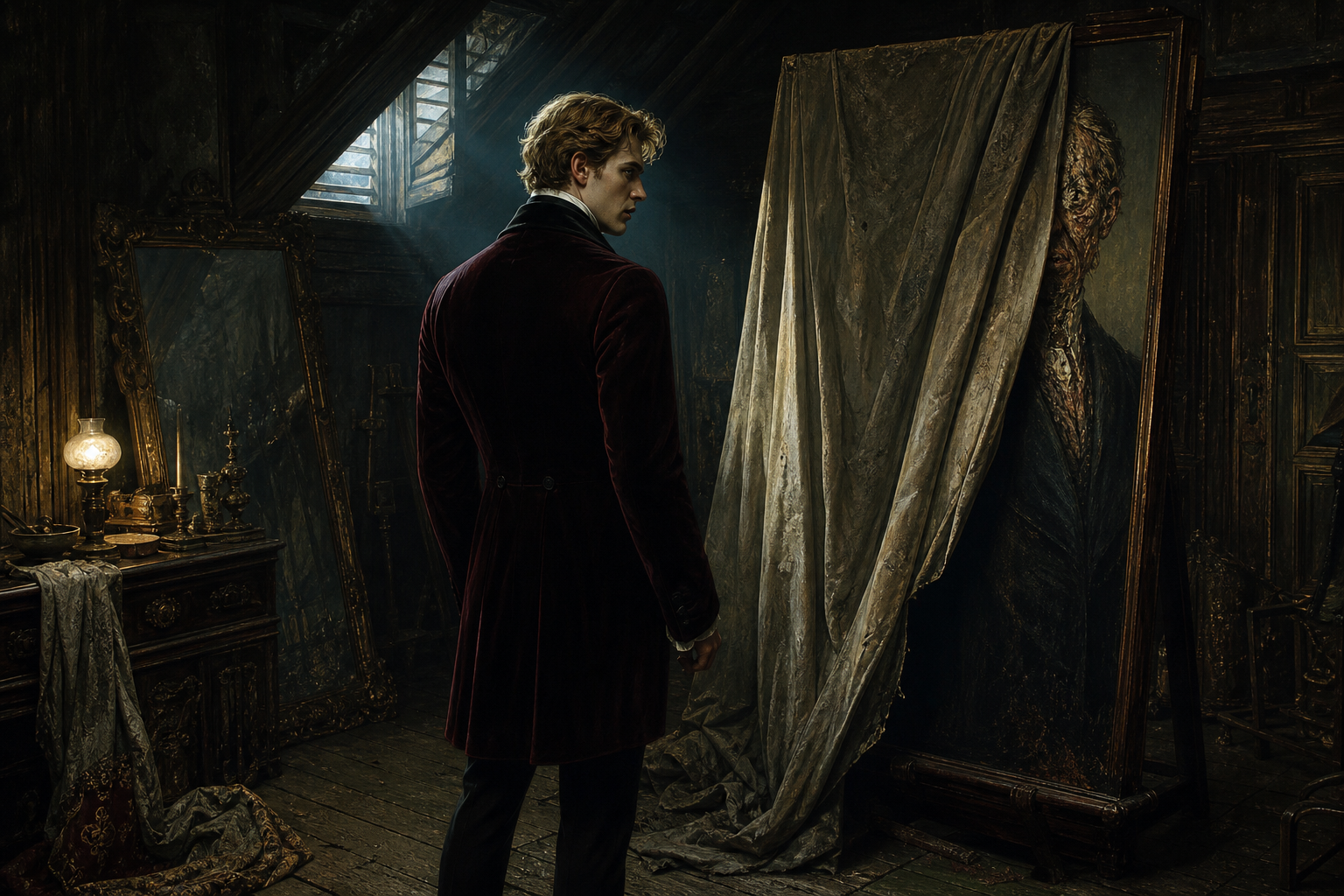
이 자료의 목표
한국어로 설명하지만, 시험에서 자주 쓰는 용어와 원문 근거는 영어로 익히는 방식입니다. The Picture of Dorian Gray는 줄거리보다 초상화가 어떤 기능을 하는지, 헨리의 말이 어떻게 영향력으로 작동하는지, 예술과 도덕의 긴장이 어떻게 고딕 장치로 바뀌는지를 묻는 경우가 많습니다.
이 자료는 다음 능력을 연습합니다.
- portrait, double, conscience, aestheticism, influence를 실제 장면과 연결하기
- Dorian, Lord Henry, Basil, Sybil, Alan Campbell의 기능을 에세이 문장으로 바꾸기
- 짧은 영어 원문을 근거로 close reading 하기
- SAT Reading 스타일의 추론, 기능, 상징, 톤 문제 풀기
- AP Lit 스타일 thesis와 paragraph 방향 만들기
1. Quick Review
- Original title: The Picture of Dorian Gray
- Author: Oscar Wilde
- Book version: 1891
- Main settings: Basil Hallward's studio, London drawing rooms, Sybil Vane's theatre, Dorian's locked schoolroom, opium dens
- Genre: Gothic fiction, Victorian novel, philosophical fiction
- Central conflict: Dorian wants beauty without time and pleasure without consequence, while the portrait records what his public face conceals
- Core themes: beauty, influence, art, conscience, double life, reputation, social hypocrisy
- Common exam angles: portrait symbolism, Lord Henry's paradoxes, Basil as conscience, Sybil and performance, Gothic doubling, ending reversal
한 문장 요약은 이렇게 정리할 수 있습니다.
Dorian Gray remains outwardly young while his portrait bears the age and corruption of his choices, exposing the danger of treating life as art without responsibility.
2. 시험용 줄거리 구조
Exposition
배질 홀워드는 도리언 그레이의 초상화를 그리고, 그 그림에 자신의 감정이 너무 많이 담겼다고 느낍니다. 헨리 워튼 경은 도리언을 만나 젊음, 쾌락, 자기실현을 유혹적으로 말합니다.
Inciting Incident
도리언은 완성된 초상화를 보고 그림이 자신 대신 늙었으면 좋겠다고 바랍니다. 이 소원은 겉몸과 그림을 분리하는 초자연적 조건이 됩니다.
Rising Action
도리언은 배우 시빌 베인을 사랑하지만, 그녀의 연기가 무너진 밤 잔인하게 버립니다. 시빌의 죽음 뒤 초상화는 처음으로 변하고, 도리언은 죄책감보다 미적 해석을 선택합니다.
Complication
세월이 흐르는 동안 도리언의 얼굴은 변하지 않지만, 소문은 점점 어두워집니다. 그는 퇴폐적인 노란 책에 사로잡히고, 초상화를 잠긴 방에 숨겨 둔 채 이중생활을 이어 갑니다.
Crisis
배질은 도리언에게 소문을 해명하라고 요구합니다. 도리언은 그에게 초상화를 보여 주고, 배질이 회개를 권하자 그를 살해합니다.
Resolution
제임스 베인의 복수 위협은 우연히 사라지지만, 도리언은 초상화의 증거를 견디지 못합니다. 그는 그림을 찌르고, 초상화는 아름다움을 되찾으며 도리언의 몸은 숨겨 온 나이와 타락을 되돌려 받습니다.
시험 포인트: 초상화를 "영혼의 상징"이라고만 쓰면 부족합니다. 초상화는 작품, 분신, 양심, 증거, 비밀, 최종 심판자의 기능을 차례로 바꿔 갑니다.
3. 핵심 원문 구절 읽기
아래 Passage들은 외울 문장 목록이 아니라 close reading 연습용입니다. 각 구절은 장면 맥락, 단어 선택, 문장 구조, 주제 연결을 함께 봐야 합니다.
Passage 1: art and morality
There is no such thing as a moral or an immoral book.
맥락: 와일드의 서문은 예술을 단순한 도덕 잣대로 판단하려는 태도에 맞섭니다.
읽는 법: moral과 immoral의 대칭은 독자의 익숙한 분류를 흔듭니다. 하지만 이 문장을 "아무 책임도 없다"로 읽으면 도리언의 오독을 반복하게 됩니다. 소설은 예술의 자율성과 삶의 책임을 일부러 긴장시킵니다.
Essay use: Use it to discuss the tension between Wilde's preface and Dorian's behavior. A strong essay distinguishes artistic freedom from moral evasion.
Passage 2: surface and peril
Those who go beneath the surface do so at their peril.
맥락: 서문은 예술의 표면과 상징을 읽는 일이 위험할 수 있다고 말합니다.
읽는 법: surface는 단순히 얕은 겉모습이 아닙니다. 도리언의 얼굴, 초상화, 사회적 평판은 모두 표면이지만 서로 다른 진실을 보여 주거나 가립니다.
Essay use: Use it for essays about appearance, interpretation, and the way the portrait turns surface into evidence.
Passage 3: the wish
If it were I who was to be always young!
맥락: 헨리의 말에 흔들린 도리언은 자신의 초상화를 보고 늙음에 대한 공포를 느낍니다.
읽는 법: 감탄문은 아름다움에 대한 감상이 질투와 두려움으로 바뀌는 순간을 드러냅니다. 도리언은 그림을 사랑하는 동시에 그림을 미워합니다.
Essay use: Use it to connect youth, mortality, influence, and the beginning of Gothic doubling.
Passage 4: language as influence
Words! Mere words! How terrible they were!
맥락: 도리언은 헨리의 연설이 자신에게 미친 충격을 이렇게 느낍니다.
읽는 법: mere는 말을 사소하게 만드는 단어인데, 바로 뒤에서 terrible이 나옵니다. 이 모순은 말이 장식이 아니라 욕망을 바꾸는 힘이라는 사실을 보여 줍니다.
Essay use: Use it to analyze Lord Henry's influence through style, rhythm, paradox, and emotional timing.
Passage 5: Sybil and illusion
You have killed my love.
맥락: 도리언은 시빌의 연기가 형편없어진 밤 그녀를 버립니다.
읽는 법: 이 문장은 책임을 뒤집습니다. 시빌이 사랑을 죽인 것이 아니라, 도리언이 예술적 환상을 잃자 사람을 사랑할 능력을 버린 것입니다.
Essay use: Use it for essays about performance, objectification, and the human cost of aesthetic worship.
Passage 6: the soul made visible
The soul is a terrible reality.
맥락: 배질은 변해 버린 초상화를 보고 도리언에게 회개를 요구합니다.
읽는 법: soul이라는 추상명사가 reality와 붙으면서 실제 눈앞의 사물처럼 느껴집니다. 초상화는 내면을 외부 이미지로 만든 고딕 장치입니다.
Essay use: Use it to discuss Gothic externalization and the portrait as visible conscience.
Passage 7: divided self
Each of us has Heaven and Hell in him.
맥락: 헨리 경은 인간 안의 모순을 재치 있게 말합니다.
읽는 법: 문장은 가볍게 들리지만, 소설은 이 분열을 실제 구조로 만듭니다. 도리언의 얼굴과 초상화는 천국과 지옥처럼 분리되어 보이지만 결국 같은 사람의 기록입니다.
Essay use: Use it for essays on the divided self, especially in comparison with Gothic doubles such as Jekyll and Hyde.
4. Close Reading: 표면, 영향, 초상화
The Picture of Dorian Gray close reading에서 가장 흔한 실수는 "초상화는 영혼이다" 또는 "헨리가 도리언을 망쳤다"에서 멈추는 것입니다. 더 좋은 답안은 표면, 말, 선택, 사회적 시선이 어떻게 함께 작동하는지 설명합니다.
1단계: 어떤 표면을 믿고 있는지 보기
작품에는 여러 표면이 나옵니다. 도리언의 얼굴, 배질의 초상화, 시빌의 연기, 사교계의 평판, 헨리의 문장 모두 표면입니다. 그런데 이 표면들은 같은 기능을 하지 않습니다. 도리언의 얼굴은 죄를 숨기는 표면이고, 초상화는 숨겨진 죄를 드러내는 표면입니다.
따라서 "겉모습은 거짓이다"라고만 쓰면 부족합니다. 와일드는 어떤 표면은 거짓을 만들고, 어떤 표면은 진실을 보여 준다는 더 복잡한 구조를 만듭니다. 에세이에서는 먼저 표면의 종류를 말하고, 그 표면이 누구를 속이거나 누구에게 진실을 보여 주는지 설명해야 합니다.
2단계: 영향력을 사건보다 언어로 추적하기
헨리는 도리언에게 직접 명령하지 않습니다. 그는 어떤 욕망이 지적이고 용감하고 아름다운 것처럼 들리게 만듭니다. 도리언이 헨리의 말을 terrible하다고 느끼는 것은, 말이 이미 그의 욕망의 방향을 바꾸었기 때문입니다.
좋은 답안은 헨리에게 모든 책임을 넘기지 않습니다. 헨리는 언어를 제공하고, 도리언은 그 언어가 자신을 편하게 해 주는 방식으로 선택합니다. 이 차이를 쓰면 character analysis가 훨씬 탄탄해집니다.
3단계: 예술지상주의와 도리언의 행동을 구별하기
와일드의 서문은 예술을 도덕 검열에서 떼어 놓으려는 주장입니다. 하지만 도리언은 그 생각을 "내 행동도 책임질 필요가 없다"는 식으로 잘못 읽습니다. 이 둘은 연결되어 있지만 같은 말은 아닙니다.
에세이에서 aestheticism을 쓸 때는 조심해야 합니다. 이 소설은 "예술은 나쁘다"고 단순히 말하지 않습니다. 오히려 아름다움의 언어가 공감과 자기 인식에서 분리될 때 얼마나 위험해지는지를 보여 줍니다. 문제는 아름다움이 아니라, 아름다움을 진실을 피하는 도구로 쓰는 도리언입니다.
4단계: 초상화의 기능을 여러 단계로 나누기
초상화는 하나의 상징만이 아닙니다. 처음에는 배질의 예술 작품이고, 도리언에게는 늙음의 공포를 보여 주는 거울입니다. 시빌 이후에는 양심의 증거가 되고, 중반부에는 도리언이 숨겨 둔 비밀 기록이 됩니다. 배질에게 공개되는 순간에는 죄의 증거가 되며, 마지막에는 도리언을 심판하는 대상처럼 작동합니다.
이렇게 기능을 나누면 "초상화는 영혼이다"보다 훨씬 구체적인 thesis를 만들 수 있습니다. 예를 들어 "The portrait changes from an admired artwork into a hidden archive of Dorian's moral history"처럼 쓰면 장면 변화와 상징 변화를 함께 잡을 수 있습니다.
적용 예시: 초상화의 첫 변화
기본 상황: 도리언은 시빌을 버린 뒤 초상화의 입가가 잔인하게 변한 것을 발견합니다.
근거: 변한 입가, 숨겨진 방, 자신이 본 것을 합리화하려는 도리언의 반응.
장치: Gothic doubling, visual symbolism, irony.
의미: 초상화는 도리언이 시빌의 고통을 "비극적 장면"으로 포장하려는 바로 그 순간, 그의 잔인함을 이미지로 고정합니다.
Essay sentence: Wilde uses the portrait's first alteration to transform conscience into image, forcing Dorian to see that a beautiful surface can hide but not erase moral injury.
답안을 쓸 때는 이 장면을 단순한 판타지 장치로만 보지 마세요. 시빌의 죽음과 초상화의 변화는 함께 읽어야 합니다. 도리언은 말을 통해 죄책감을 약화하려 하지만, 그림은 언어보다 먼저 진실을 보여 줍니다. 그래서 이 장면은 도리언의 이중생활이 시작되는 순간이면서, 동시에 그 이중생활이 결코 완전히 성공할 수 없다는 예고입니다.
5. 문학 장치: 바로 쓰는 장치 8개
문학 장치를 쓸 때는 장치 이름만 나열하면 점수가 오르지 않습니다. Gothic double, paradox, symbolism, irony 같은 용어는 evidence와 commentary 사이를 연결할 때 의미가 있습니다.
1. Gothic Double
초상화는 도리언의 두 번째 자아입니다. 도리언의 몸이 거부하는 나이와 죄의 흔적을 그림이 대신 짊어집니다. 이 장치는 숨겨진 죄책감을 고백이 아니라 이미지로 드러냅니다.
2. Paradox
헨리 경은 모순처럼 들리는 문장으로 말합니다. 그의 말은 도덕 판단을 잠시 멈추게 만들 만큼 세련됩니다. 그래서 도리언은 위험한 욕망을 지적인 자유처럼 느끼게 됩니다.
3. Symbolic Setting
화실, 극장, 잠긴 방, 아편굴은 모두 다른 의미를 가집니다. 화실은 도리언을 예술 작품으로 만들고, 극장은 사람을 배역으로 오해하게 하며, 잠긴 방은 양심을 숨기고, 아편굴은 상류층 쾌락의 어두운 결과를 드러냅니다.
4. Irony
도리언의 얼굴은 순수해 보이지만, 그 순수함이 부패를 숨기는 도구가 됩니다. 더 아름다워 보일수록 사회는 그를 의심하지 않으려 합니다.
5. Allusion
소설에는 셰익스피어, 음악, 보석, 종교적 장식, 프랑스 퇴폐문학 같은 문화적 참조가 많습니다. 이것들은 도리언이 삶을 하나의 큐레이션된 전시처럼 만들고 싶어 한다는 사실을 보여 줍니다.
6. Foil
배질, 헨리, 시빌, 도리언은 모두 아름다움에 다르게 반응합니다. 배질은 숭배하고, 헨리는 말로 실험하고, 시빌은 실제 감정으로 바뀌며, 도리언은 소유하려 합니다. 이 차이는 "아름다움이 곧 타락"이라는 단순한 결론을 막아 줍니다.
7. Motif of Secrecy
닫힌 방, 덮개, 소문, 협박은 모두 도리언의 삶이 은폐를 중심으로 움직인다는 것을 보여 줍니다. 숨기는 행위가 반복될수록 숨겨진 것은 더 큰 힘을 갖습니다.
8. Ending Reversal
마지막에는 그림과 몸의 역할이 뒤집힙니다. 초상화가 아름다움을 되찾고 도리언의 몸이 추해지는 반전은 표면과 진실의 분리를 끝냅니다.
에세이에서는 장치 하나를 고른 뒤 장면, 효과, 주제를 연결하세요. 예를 들어 paradox를 고른다면 "헨리가 역설을 사용한다"에서 멈추지 말고, 그 역설이 도리언에게 죄책감을 세련된 생각처럼 느끼게 만드는 과정을 설명해야 합니다.
6. 인물 분석을 영어 답안으로 바꾸기
인물 분석은 성격표를 만드는 일이 아닙니다. AP Lit 에세이에서는 인물이 작품의 핵심 압력을 운반합니다. 도리언은 아름다움과 면책 욕망, 헨리는 언어와 영향력, 배질은 예술과 양심, 시빌은 연기와 인격, 제임스와 앨런은 숨겨진 삶의 결과를 보여 줍니다.
답안을 쓰기 전 네 가지를 잡아 보세요.
- Role: 이 인물이 작품 전체에서 맡는 기능은 무엇인가?
- Pressure: 이 인물을 움직이는 욕망, 두려움, 이상, 사회적 기대는 무엇인가?
- 장치: 와일드는 이 인물을 대화, 공간, 대비, 상징, 아이러니 중 무엇으로 보여 주는가?
- Essay sentence: 이 인물로 작품 전체 의미에 대해 어떤 주장 문장을 만들 수 있는가?
예시 문장은 영어 에세이에 바로 옮길 수 있도록 영어로 둡니다. 다만 외울 문장이 아니라, 장면 근거를 붙여 paragraph로 확장하는 출발점으로 사용하세요.
Dorian Gray
beautiful surface divided from moral record
Essay sentence: Dorian's tragedy lies in his attempt to turn beauty into immunity, while the portrait preserves the history his face conceals.
Lord Henry
speaker whose wit becomes temptation
Essay sentence: Lord Henry's influence works through style: he makes selfish desire sound like intellectual freedom before Dorian turns the performance into practice.
Basil Hallward
artist whose idealism becomes conscience
Essay sentence: Basil's portrait begins as an act of worship but becomes the only image honest enough to challenge Dorian's self-deception.
Sybil Vane
actress who exposes the cruelty of aesthetic possession
Essay sentence: Sybil's failed performance reveals that Dorian loves artifice more than personhood, making her humanity the first casualty of his philosophy.
James Vane and Alan Campbell
consequence returning through bodies and coercion
Essay sentence: James and Alan show that Dorian's hidden life is not merely inward corruption; it produces fear, blackmail, ruined trust, and physical danger.
7. Thesis Builder for Major Themes
좋은 thesis는 주제어 하나만 던지지 않습니다. theme, literary device, meaning of the work as a whole을 함께 연결해야 합니다. 예를 들어 "The portrait symbolizes Dorian's soul"은 주제문에 가깝고, "The portrait changes from admired artwork into hidden moral evidence"처럼 기능 변화와 의미를 함께 말해야 논제가 됩니다.
Beauty
Surface
Weak thesis: Dorian is beautiful.
Strong thesis: Wilde makes Dorian's beauty socially powerful enough to delay judgment, showing how admiration can become a form of moral blindness.
Influence
Language
Weak thesis: Lord Henry influences Dorian.
Strong thesis: Lord Henry's language does not remove Dorian's agency; it gives Dorian a seductive vocabulary for choices he later owns.
Art
Aestheticism
Weak thesis: Art is bad in the novel.
Strong thesis: Wilde defends art from simplistic moral policing while exposing Dorian's misuse of aesthetic ideas as an escape from accountability.
Double
Hidden Self
Weak thesis: The portrait is Dorian's soul.
Strong thesis: The portrait functions as artwork, double, conscience, and evidence, changing from beautiful object into the record Dorian cannot publicly bear.
8. SAT Reading Sample
아래 문항은 SAT Reading 형식으로 만든 연습문제이며 College Board 공식 문제가 아닙니다. 문제와 선택지는 실제 시험 감각을 위해 영어로 두고, 해설은 한국어로 작품의 장면 근거와 오답 제거 논리를 설명합니다.
Question 1
The preface's claim about moral and immoral books primarily challenges:
- A. the need for any artistic form
- B. simple moral labeling of art
- C. Basil's ability to paint
- D. Sybil's theatrical training
Answer: B. 서문은 예술을 단순한 도덕 분류로 판단하는 태도에 맞섭니다. 다른 보기는 해당 문장의 핵심 논점에서 벗어납니다.
Question 2
Basil's reluctance to exhibit Dorian's portrait suggests that:
- A. the picture feels too personally revealing
- B. the portrait is technically unfinished
- C. Lord Henry owns the studio
- D. Dorian has forbidden all painting
Answer: A. 배질은 그림에 자신이 너무 많이 들어갔다고 느낍니다. 그래서 전시는 기술 문제가 아니라 감정적 노출의 문제가 됩니다.
Question 3
Lord Henry's first effect on Dorian is best described as:
- A. giving Dorian a philosophy for fearing age
- B. teaching Dorian to paint landscapes
- C. persuading Dorian to avoid society
- D. proving Basil dislikes beauty
Answer: A. 헨리의 말은 젊음과 늙음에 대한 도리언의 감각을 바꿉니다. 이후 초상화 앞에서의 소원이 이 영향과 연결됩니다.
Question 4
Dorian's wish about the portrait is important because it:
- A. ends Basil's career immediately
- B. restores Sybil's acting
- C. explains Henry's childhood
- D. creates the novel's divided body-and-image structure
Answer: D. 도리언의 소원은 몸과 이미지가 서로 다른 기록을 갖는 구조를 만듭니다. 이 분리가 작품 전체의 고딕 장치를 형성합니다.
Question 5
Dorian loves Sybil at first mainly as:
- A. a political leader
- B. an embodiment of dramatic art
- C. Basil's rival painter
- D. James Vane's guardian
Answer: B. 도리언은 시빌을 한 사람보다 배역과 연기의 구현으로 봅니다. 그래서 연기가 무너지자 사랑도 무너졌다고 착각합니다.
Question 6
The portrait's first change after Dorian rejects Sybil functions as:
- A. comic relief
- B. a financial contract
- C. visible evidence of cruelty
- D. a travel map
Answer: C. 초상화의 변화는 도리언이 외면하려는 잔인함을 눈에 보이는 증거로 만듭니다. 이것이 양심의 이미지화입니다.
Question 7
Lord Henry's response to Sybil's death encourages Dorian to:
- A. treat tragedy as aesthetic experience
- B. confess publicly at once
- C. give up all beauty
- D. destroy the yellow book
Answer: A. 헨리는 죽음을 미적 비극처럼 해석합니다. 도리언은 그 말을 통해 죄책감을 감상으로 바꾸는 법을 배웁니다.
Question 8
The locked schoolroom mainly represents:
- A. open public accountability
- B. Dorian's attempt to hide conscience
- C. Sybil's professional success
- D. Basil's childhood home
Answer: B. 잠긴 방은 도리언이 초상화와 양심을 사회적 시선에서 숨기는 공간입니다. 공개가 아니라 은폐가 핵심입니다.
Question 9
The yellow book influences Dorian because it:
- A. provides a script for cultivated sensation
- B. proves Henry is poor
- C. prevents all rumors
- D. explains Basil's murder in advance
Answer: A. 도리언은 그 책을 감각과 분위기를 조직하는 삶의 모델처럼 읽습니다. 책은 줄거리보다 생활 방식에 영향을 줍니다.
Question 10
Society's willingness to keep inviting Dorian despite rumors shows:
- A. the power of appearance and class protection
- B. the total absence of gossip
- C. Basil's public confession
- D. James Vane's social popularity
Answer: A. 도리언의 아름다움과 지위는 소문을 약화시키는 방패처럼 작동합니다. 와일드는 사교계의 선택적 믿음을 비판합니다.
Question 11
Basil's confrontation with Dorian is driven mainly by:
- A. a desire to sell the portrait abroad
- B. hatred of all art
- C. hope that Dorian can still tell the truth
- D. fear of Sybil's acting teacher
Answer: C. 배질은 도리언이 소문을 부정하거나 회개하길 바랍니다. 그는 예술가이면서 양심의 역할을 맡습니다.
Question 12
Dorian's murder of Basil is especially significant because Basil:
- A. has never known Dorian
- B. is the person who created and still morally reads the portrait
- C. works for James Vane
- D. rejects painting as a practice
Answer: B. 배질은 초상화를 만든 사람이자 그 그림을 도덕적 증거로 읽을 수 있는 사람입니다. 그를 죽이는 행위는 진실의 목격자를 제거하는 일입니다.
Question 13
Alan Campbell's role shows that Dorian's corruption:
- A. harms only Dorian's imagination
- B. has no connection to other people
- C. can be forced onto former friends through blackmail
- D. is resolved by music alone
Answer: C. 앨런은 협박 때문에 범죄 은폐에 끌려 들어갑니다. 도리언의 타락은 내면 문제를 넘어 타인의 삶까지 훼손합니다.
Question 14
James Vane nearly fails to identify Dorian because:
- A. Dorian's unchanged youth contradicts the passage of years
- B. James cannot remember Sybil
- C. Lord Henry hides the portrait
- D. Basil warns him away
Answer: A. 도리언의 얼굴이 너무 젊기 때문에 제임스는 시간이 흐른 사실과 눈앞의 모습을 연결하지 못합니다.
Question 15
The opium-den scenes most strongly connect Dorian's life to:
- A. pure pastoral innocence
- B. public school comedy
- C. royal ceremony
- D. the social damage beneath aristocratic pleasure
Answer: D. 아편굴은 도리언의 세련된 쾌락이 어떤 어두운 도시적 결과와 연결되는지 보여 줍니다.
Question 16
Dorian's attempt to count sparing Hetty as reform fails because:
- A. the portrait suggests vanity and hypocrisy rather than true change
- B. Henry forces him to marry her
- C. Basil returns unharmed
- D. James becomes his servant
Answer: A. 초상화는 도리언의 행동을 진정한 회개가 아니라 자기만족과 위선으로 드러냅니다.
Question 17
The ending's exchange between portrait and body reveals that:
- A. appearance and hidden truth can remain divided forever
- B. Dorian's concealed history finally becomes visible on his body
- C. the portrait was never important
- D. society had understood everything from the beginning
Answer: B. 마지막에는 그림이 짊어지던 나이와 타락이 도리언의 몸으로 돌아옵니다. 숨겨진 기록이 보이는 몸이 됩니다.
Question 18
Wilde's use of witty dialogue mainly:
- A. removes all danger from the novel
- B. makes the novel a legal document
- C. gives temptation an attractive surface
- D. eliminates characterization
Answer: C. 위트 있는 대화는 위험한 생각을 매력적으로 보이게 합니다. 특히 헨리의 말은 유혹의 표면을 만듭니다.
Question 19
The best description of Basil's tragedy is that he:
- A. sees beauty as meaningful but misjudges Dorian's moral depth
- B. never values art
- C. controls Lord Henry completely
- D. causes Sybil's poor acting
Answer: A. 배질은 아름다움을 깊이 있는 가능성으로 믿지만, 도리언의 도덕적 약함을 충분히 보지 못합니다.
Question 20
The novel's treatment of art is best described as:
- A. simple proof that all art corrupts
- B. a ban on interpretation
- C. a purely comic defense of gossip
- D. a tension between art's autonomy and life lived without accountability
Answer: D. 작품은 예술의 자율성을 옹호하면서도, 미학적 언어가 책임 회피에 쓰일 때의 위험을 보여 줍니다.
9. AP Lit Essay Questions
아래 AP Lit 스타일 질문은 특정 장면을 thesis, outline, evidence-based commentary로 바꾸는 연습용입니다. 질문은 영어 답안 연습을 위해 영어로 유지합니다.
Essay Question 1
Analyze how Wilde uses Basil's studio in the opening chapters to introduce beauty, artistic creation, influence, and danger.
Essay Question 2
Lord Henry often speaks in paradoxes. Explain how his style shapes Dorian's imagination without removing Dorian's responsibility.
Essay Question 3
Dorian's first view of the portrait changes his relation to time. Analyze how the portrait transforms beauty into fear.
Essay Question 4
Analyze Sybil Vane's role in the novel's treatment of art, performance, and personhood.
Essay Question 5
The portrait first changes after Dorian rejects Sybil. Explain how this moment turns conscience into visible form.
Essay Question 6
Compare Basil's love of beauty with Lord Henry's love of influence. What different moral risks does each man represent?
Essay Question 7
Analyze the function of the yellow book in Dorian's development. How does reading become a model for living?
Essay Question 8
Discuss how Wilde uses rumors and social invitations to criticize Victorian respectability.
Essay Question 9
The locked room is one of the novel's most important settings. Analyze how secrecy changes Dorian's relation to guilt.
Essay Question 10
Explain how Basil's final confrontation with Dorian revises the meaning of the portrait.
Essay Question 11
Analyze Dorian's murder of Basil as a symbolic act as well as a plot event.
Essay Question 12
Alan Campbell appears briefly but memorably. Discuss how his role expands the consequences of Dorian's corruption.
Essay Question 13
James Vane turns the past into a threat. Analyze how his pursuit challenges Dorian's dependence on youthful appearance.
Essay Question 14
Discuss the novel's use of Gothic conventions such as doubling, secret rooms, hidden guilt, and final revelation.
Essay Question 15
Wilde's preface seems to defend art from morality. Analyze how the novel complicates, tests, or dramatizes that defense.
Essay Question 16
Analyze the role of theatrical language and performance in the novel, including Sybil's acting and Dorian's social persona.
Essay Question 17
The ending restores the portrait and destroys Dorian. Explain how this reversal resolves the novel's conflict between surface and record.
Essay Question 18
Read the novel as a critique of influence. Use at least two characters to explain how speech, admiration, or reputation changes behavior.
Essay Question 19
Analyze how Wilde presents beauty as both gift and danger.
Essay Question 20
Discuss whether the novel should be read primarily as moral fable, aesthetic experiment, Gothic horror, or social satire. Build an argument that can account for more than one mode.
10. 모델 thesis bank: 영어 논제 예시
아래 문장들은 모델 thesis입니다. 그대로 외우기보다 실제 질문의 동사와 장면 요구에 맞게 조정하세요.
- Wilde uses Basil's studio as a charged artistic space where beauty first appears sacred, social, and dangerous at the same time.
- Lord Henry's paradoxes tempt Dorian because they make self-indulgence sound like intellectual courage, but Dorian remains responsible for turning talk into action.
- The portrait transforms beauty from a source of admiration into a measure of mortality, creating Dorian's desire to separate surface from time.
- Sybil Vane exposes Dorian's inability to love a person once she stops functioning as an aesthetic illusion.
- The first alteration of the portrait turns private cruelty into visible evidence, making conscience impossible to dismiss completely.
- Basil's reverence and Henry's detachment reveal two different dangers in responding to beauty: idealization and experimentation.
- The yellow book gives Dorian a script of cultivated sensation, showing how reading can become self-fashioning when separated from judgment.
- Society's continued acceptance of Dorian reveals a culture willing to protect beauty and status from the consequences of rumor.
- The locked room externalizes repression by making guilt both hidden from society and constantly available to Dorian's private gaze.
- Basil's final confrontation changes the portrait from private secret into moral proof, forcing Dorian to face an honest witness.
- Dorian's murder of Basil symbolically destroys the artist-conscience who can still connect beauty with truth.
- Alan Campbell's coerced assistance proves that Dorian's secrecy creates practical harm, not merely inward decay.
- James Vane threatens Dorian because revenge reads past the beautiful face and insists that history still matters.
- Wilde adapts Gothic doubling to a fashionable social world, making terror emerge from salons, artworks, and reputation rather than remote castles.
- The preface and plot create productive tension: art resists simple moral labeling, yet aesthetic language can become morally dangerous in Dorian's hands.
- Performance in the novel moves from theatre to society, showing Dorian learning to act innocence after losing it.
- The ending restores the portrait's beauty because the hidden record returns to Dorian's body, collapsing the split he has depended on.
- Influence in the novel is powerful because it operates through admiration, style, and timing rather than direct command.
- Wilde presents beauty as dangerous when it becomes social evidence strong enough to silence suspicion and self-knowledge.
- The novel works as Gothic horror and social satire because Dorian's supernatural secret depends on a very ordinary culture of appearances.
11. 에세이용 academic vocabulary
- aestheticism: beauty, form, and art's autonomy를 중시하는 예술관
- preface: 작품의 읽는 방식을 제시하는 서문
- paradox: 모순처럼 보이지만 의미를 드러내는 진술
- epigram: 짧고 재치 있으며 기억에 남는 문장
- Gothic double: 숨겨진 정체성을 드러내는 두 번째 자아
- symbolism: 사물, 이미지, 행동이 여러 층의 의미를 갖는 방식
- conscience: 내면의 도덕적 인식과 판단
- decadence: 세련된 과잉과 쇠퇴의 분위기
- influence: 다른 사람의 생각과 욕망을 형성하는 힘
- agency: 선택하고 행동할 수 있는 능력
- social hypocrisy: 공적 도덕과 사적 행동이 어긋나는 상태
- reputation: 사회적 평판과 공개 이미지
- objectification: 사람을 대상, 이미지, 기능처럼 대하는 태도
- foreshadowing: 뒤의 사건을 예고하는 장면이나 표현
- irony: 겉모습과 실제, 말과 의미, 기대와 결과의 차이
- allusion: 다른 작품, 문화, 전통에 대한 암시
- motif: 반복되는 이미지, 생각, 패턴
- doubling: 서로 비추고 왜곡하는 분리된 정체성
- confession: 죄나 진실을 인정하는 행위
- commentary: 근거가 주장을 어떻게 뒷받침하는지 설명하는 부분