프랑켄슈타인 학습자료 - 미국 유학, AP English, SAT Reading 대비
영어 원문을 근거로 AP English Literature, SAT Reading, IB English, 미국 고등학교 에세이까지 연결하는 실전 학습 가이드입니다.
이 학습자료는 미국식 문학 수업과 영어 에세이 작성을 목표로 합니다. 작품 전체 흐름을 먼저 잡고 싶다면 본문 해설을 먼저 읽어도 좋습니다.
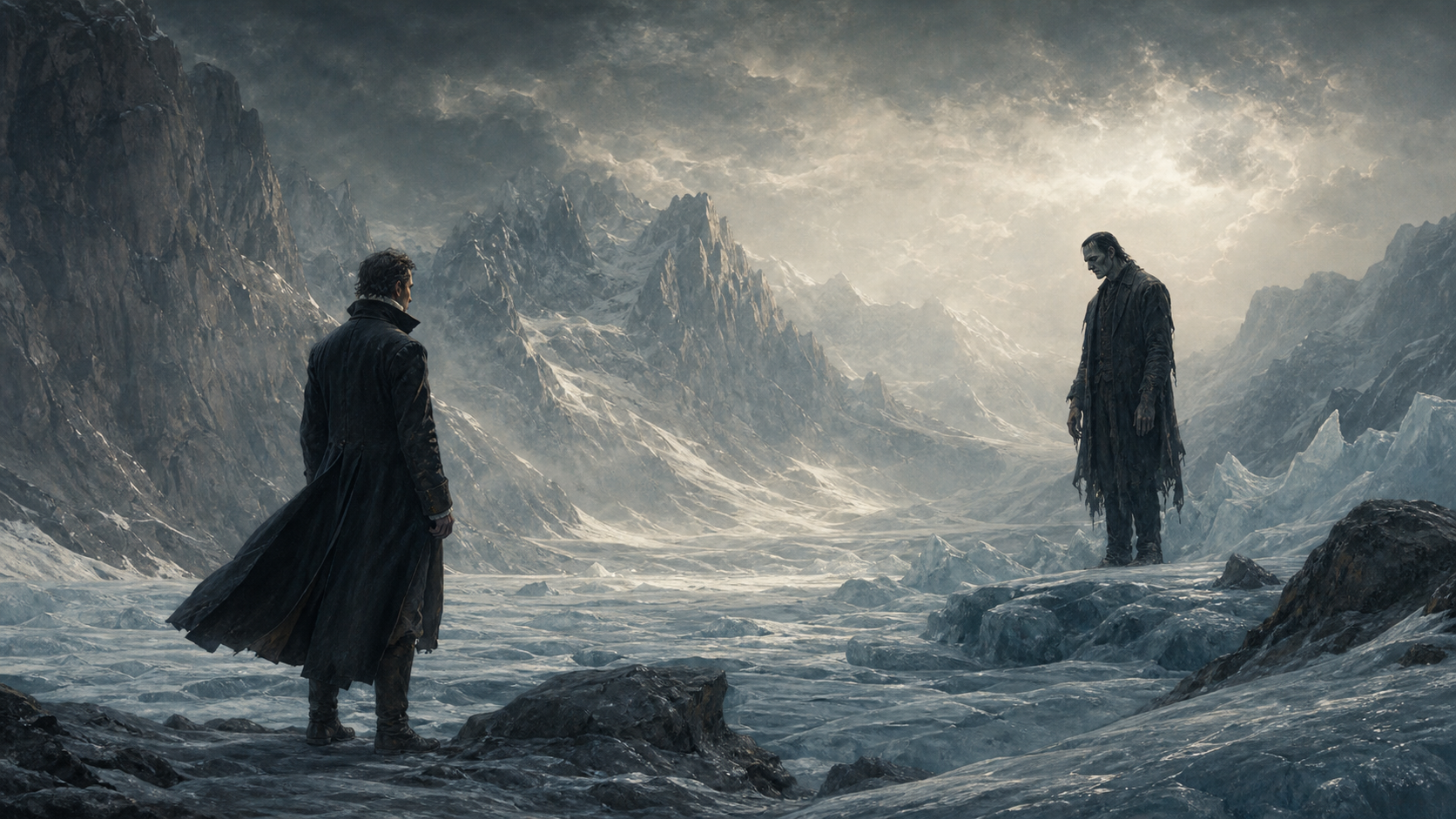
이 자료의 목표
한국어로 설명하지만, 실제 시험과 수업에서 필요한 표현은 영어로 익히는 방식입니다. 미국 고등학교, AP English Literature, IB English, SAT Reading에서는 단순 줄거리보다 짧은 원문 근거를 사용해 문학적 의미를 설명하는 능력을 중요하게 봅니다.
이 자료는 다음 능력을 연습합니다.
- Victor, Walton, the creature의 서술 구조 이해하기
- creation, responsibility, isolation, ambition 같은 핵심 개념을 영어로 설명하기
- 짧은 원문 구절을 근거로 close reading 하기
- AP Lit 스타일 thesis와 paragraph 방향 만들기
- SAT Reading 스타일 추론, 기능, 어휘 문제에 익숙해지기
1. Quick Review
- Original title: Frankenstein; Or, The Modern Prometheus
- Author: Mary Wollstonecraft Shelley
- Published: 1818; revised edition 1831
- Main settings: Geneva, Ingolstadt, the Alps, the Orkneys, Ireland, the Arctic
- Narrators: Walton, Victor Frankenstein, and the creature
- Central conflict: Victor creates life, abandons it, and is pursued by the consequences
- Core themes: creation and responsibility, isolation, ambition, appearance and judgment, revenge, education
- Exam focus: frame narration, Prometheus allusion, the creature's education, sublime nature, Victor's self-defense
한 문장 요약은 이렇게 정리할 수 있습니다.
Victor Frankenstein creates a living being and rejects him, turning scientific ambition into a tragedy about responsibility, loneliness, and revenge.
2. 시험용 줄거리 구조
Exposition
Walton이 북극 탐험 중 빅터를 구조합니다. 월턴의 야망은 빅터의 야망을 비추는 거울이므로, 액자식 구성 자체가 시험 포인트입니다.
Rising Action
빅터는 잉골슈타트에서 생명의 원리를 연구하고 창조물을 만듭니다. 그러나 그는 창조물을 보자마자 버립니다. 이후 윌리엄의 죽음과 저스틴의 처형을 통해 빅터의 실험은 사회적 피해로 번집니다.
Creature's Narrative
창조물은 드 라세 가족을 관찰하며 언어와 감정, 도덕 감각을 배웁니다. 그는 책을 읽고 자신을 이해하지만, 사회는 외모만 보고 그를 거부합니다.
Climax
빅터는 만들던 여성 창조물을 파괴합니다. 이 순간 창조물은 복수를 확정하고, 이야기는 돌이킬 수 없는 방향으로 진행됩니다.
Resolution
빅터는 북극에서 죽고, 창조물은 그의 죽음을 슬퍼합니다. 월턴은 귀환을 선택합니다. 시험 답안에서는 이 결말을 "ambition can still be corrected if warning is heard"라는 방향으로 정리할 수 있습니다.
3. 핵심 원문 구절 읽기
이 구간은 단순히 "외울 만한 문장"을 모아 둔 목록이 아닙니다. 미국식 문학 수업에서는 짧은 원문 한 줄을 가져와도 그 문장이 놓인 장면, 말하는 사람의 위치, 단어 선택, 문장 리듬, 작품 전체의 주제까지 연결해야 합니다. 그래서 아래 Passage들은 모두 영어 원문을 그대로 두고, 장면 맥락과 close reading 방향을 함께 정리했습니다.
읽을 때는 먼저 문장의 표면 의미를 확인한 뒤, 눈에 띄는 단어를 표시하세요. 그 다음 그 단어가 인물의 욕망, 두려움, 권력, 계급, 정체성, 죄책감, 자유 같은 추상적 주제를 어떻게 보이게 만드는지 생각하면 됩니다. 좋은 답안은 "이 문장은 중요하다"에서 끝나지 않습니다. "이 문장의 특정 표현이 작품 전체의 의미를 이렇게 바꾼다"까지 말해야 합니다.
한국어 학습자는 원문을 번역해 이해하는 단계에서 멈추기 쉽습니다. 하지만 AP English, SAT Reading, IB English, 미국 학교 essay에서는 번역보다 evidence -> interpretation -> claim의 연결이 중요합니다. 아래 구절마다 Context, Close reading, Essay use를 따로 둔 이유도 이 때문입니다. 먼저 영어 문장을 읽고, 이어서 한국어 해설을 통해 답안 문장으로 바꾸는 훈련을 해보세요.
Passage 1: Learn from me
Learn from me, if not by my precepts, at least by my example, how dangerous is the acquirement of knowledge.
맥락: 빅터는 월턴에게 자신의 이야기를 단순한 회상이 아니라 경고로 제시합니다. 액자식 구성 때문에 이 문장은 독자뿐 아니라 또 다른 야심가인 월턴을 향합니다.
읽는 법: Learn from me, precepts, example, dangerous는 교훈적 diction입니다. 빅터는 자신의 고통을 증거로 삼아 지식 추구의 위험을 말하지만, 동시에 자신의 책임 회피를 얼마나 인정하는지 독자가 판단해야 합니다.
시험 포인트: AP/IB에서는 frame narration과 unreliable warning을, SAT에서는 imperative diction이 speaker의 목적을 어떻게 드러내는지 분석할 수 있습니다.
Essay use: Shelley frames Victor's narration as a warning that tests whether ambition can learn from another person's ruin.
Passage 2: Life and death appeared to me ideal bounds
Life and death appeared to me ideal bounds, which I should first break through, and pour a torrent of light into our dark world.
맥락: 빅터는 생명 창조를 상상하며 자연의 한계를 넘어설 수 있다고 믿습니다. 아직 창조물을 돌보는 책임은 생각하지 않고, 발견의 영광만 앞세웁니다.
읽는 법: Life and death, bounds, break through, torrent of light, dark world는 boundary와 light imagery를 만듭니다. 문장은 영웅적 발견처럼 들리지만, I should first가 보여 주는 자기중심성이 hubris를 드러냅니다.
시험 포인트: AP/IB에서는 ambition과 responsibility의 분리를, SAT에서는 imagery가 tone을 어떻게 양면적으로 만드는지 읽으면 좋습니다.
Essay use: Victor's boundary and light imagery makes ambition sound noble while revealing his desire to master life before understanding care.
Passage 3: a new species would bless me
A new species would bless me as its creator and source; many happy and excellent natures would owe their being to me.
맥락: 빅터는 아직 존재하지 않는 새 생명들이 자신을 찬양할 미래를 상상합니다. 창조의 윤리보다 창조자로 숭배받고 싶은 욕망이 먼저 드러납니다.
읽는 법: would bless me, creator and source, owe their being to me는 모두 관계를 돌봄이 아니라 빚과 숭배로 상상합니다. 미래시제는 아직 일어나지 않은 결과를 이미 자기 영광으로 소유하려는 태도를 보여 줍니다.
시험 포인트: AP/IB에서는 creation과 pride를, SAT에서는 speaker's expectation과 motive를 묻는 문제로 연결됩니다.
Essay use: Victor's fantasy of being blessed as creator exposes ethical blindness before the creature is even alive.
Passage 4: Adam and fallen angel
I ought to be thy Adam; but I am rather the fallen angel, whom thou drivest from joy for no misdeed.
맥락: 알프스에서 창조물은 빅터에게 자신이 어떤 존재로 여겨져야 했는지 직접 말합니다. 이 장면은 창조물을 침묵하는 괴물이 아니라 읽고 해석하고 고발하는 화자로 바꿉니다.
읽는 법: Adam은 창조자에게 돌봄을 받아야 할 첫 인간의 이미지를, fallen angel은 배제와 타락의 이미지를 불러옵니다. I ought to be...but I am rather...의 대조 구조는 원래 있어야 할 관계와 실제 버려진 상태를 분명히 나눕니다.
시험 포인트: AP/IB에서는 allusion과 creature's voice를, SAT에서는 contrast가 claim을 어떻게 만드는지 분석할 수 있습니다.
Essay use: The creature's Adam allusion turns abandonment into a broken creator-creation bond rather than a simple monster plot.
Passage 5: love and fear
If I cannot inspire love, I will cause fear; and chiefly towards you my arch-enemy, because my creator, do I swear inextinguishable hatred.
맥락: 창조물은 사랑을 얻지 못하면 공포를 일으키겠다고 말합니다. 이 장면은 동정 가능한 고통이 의식적인 복수로 굳어지는 전환점입니다.
읽는 법: If I cannot inspire love, I will cause fear의 조건문은 사랑과 공포를 대체 관계로 놓습니다. arch-enemy와 creator가 같은 대상인 빅터에게 붙으면서, 창조자의 책임 실패가 적대 관계로 바뀝니다.
시험 포인트: AP/IB에서는 sympathy와 moral agency의 균형을, SAT에서는 conditional syntax가 shift를 어떻게 만드는지 설명할 수 있습니다.
Essay use: Shelley makes the creature morally complex by showing how denied affection becomes chosen revenge.
Passage 6: a hell within me
I, like the arch-fiend, bore a hell within me; and finding myself unsympathised with, wished to tear up the trees.
맥락: 거절당한 뒤 창조물은 자신 안의 지옥을 말합니다. 괴물성은 외모의 문제가 아니라 고립과 분노가 내면화된 상태로 제시됩니다.
읽는 법: arch-fiend, hell within me, unsympathised with는 성서적 암시와 inward imagery를 결합합니다. 나무를 찢고 싶다는 충동은 물리적 폭력 이전에 인정받지 못한 감정의 폭발로 읽어야 합니다.
시험 포인트: AP/IB에서는 isolation과 destructive agency를, SAT에서는 figurative language가 character psychology를 어떻게 드러내는지 분석할 수 있습니다.
Essay use: The creature's inward hell shows that monstrosity becomes psychological before it becomes violent action.
Passage 7: returning to England
I am returning to England. I have lost my hopes of utility and glory; I have lost my friend.
맥락: 월턴은 북극 탐험의 영광을 포기하고 돌아가기로 합니다. 그는 빅터와 닮은 야심가이지만, 빅터의 경고를 듣고 다른 선택을 할 수 있는 인물입니다.
읽는 법: I am returning, I have lost의 단순한 반복은 과장된 영웅담이 아니라 손실을 인정하는 문장입니다. utility and glory와 my friend가 함께 사라지면서, 월턴은 명예보다 생명과 관계를 선택하는 쪽으로 이동합니다.
시험 포인트: AP/IB에서는 ending interpretation과 foil structure를, SAT에서는 plain syntax와 tonal shift를 분석하면 좋습니다.
Essay use: Walton's plain declaration of return makes the frame narrative answer Victor's tragedy with responsible restraint.
4. Close Reading: 액자 구조와 책임 읽기
Frankenstein의 close reading은 "과학자가 괴물을 만들었다"에서 멈추면 약합니다. 이 작품은 누가 이야기를 전달하는지, 창조와 돌봄이 왜 분리되는지, 창조물이 어떤 언어로 자신을 해석하는지, 월턴이 그 경고를 듣고 무엇을 선택하는지를 함께 읽어야 합니다.
1단계: 화자와 수신자를 먼저 확인하기
빅터의 이야기는 월턴의 편지 안에 들어 있고, 창조물의 이야기는 빅터의 이야기 안에 들어 있습니다. 그래서 모든 고백은 누군가를 설득하려는 말입니다. AP/IB에서는 "누가 누구에게 왜 말하는가"를 thesis에 포함하면 답안이 강해집니다.
2단계: creation과 abandonment를 분리하기
셸리가 비판하는 것은 지식 자체보다 돌봄 없는 창조입니다. 빅터의 결정적 실패는 생명을 만든 순간이 아니라, 살아난 존재를 보자마자 도망치는 순간입니다. 답안에서는 animation보다 abandonment를 중심 근거로 삼으세요.
3단계: 이미지가 빅터의 야망을 어떻게 포장하는지 보기
빅터는 bounds, light, dark world 같은 숭고하고 영웅적인 언어로 자신의 프로젝트를 말합니다. 그러나 그 언어는 책임을 가립니다. imagery를 분석할 때는 "멋진 이미지"가 아니라 "무엇을 정당화하는 이미지인가"를 물어야 합니다.
4단계: 창조물의 allusion을 인격의 증거로 읽기
창조물이 Adam, fallen angel, arch-fiend를 말할 수 있다는 것은 그가 읽고, 비교하고, 자신의 처지를 해석하는 존재임을 뜻합니다. SAT에서는 allusion function, AP/IB에서는 creature's voice와 moral agency로 연결됩니다.
Worked example: I ought to be thy Adam
Literal situation: 알프스에서 창조물은 빅터에게 자신이 원래 어떤 관계를 기대했는지 말합니다.
Evidence: Adam, fallen angel, drivest from joy, no misdeed.
Device: biblical allusion, contrast, accusatory diction.
Meaning: Adam은 창조자에게 인정받아야 할 피조물을, fallen angel은 기쁨에서 쫓겨난 존재를 뜻합니다. I ought to be...but I am rather... 구조는 빅터가 만들어야 했던 관계와 실제로 만든 버림의 관계를 대비합니다.
Essay sentence: Shelley gives the creature biblical language so that abandonment becomes an ethical accusation against the creator rather than a mere monster's complaint.
5. Literary Devices: 프랑켄슈타인에서 바로 쓰는 장치 10개
이 작품의 장치들은 creation, responsibility, isolation, voice를 함께 움직입니다. 장면 근거와 essay use를 붙여서 정리하세요.
1. Frame Narrative: 월턴, 빅터, 창조물
Scene evidence: 월턴의 편지 안에 빅터의 고백이 있고, 그 안에 창조물의 이야기가 들어 있습니다. 독자는 한 목소리가 아니라 겹겹의 자기해명을 비교해야 합니다.
Essay use: Use frame narrative to argue that the novel turns Victor's tragedy into a test for another ambitious listener.
2. Prometheus and Biblical Allusion: 위반과 책임
Scene evidence: 제목의 Prometheus 암시, 창조물의 Adam과 fallen angel 언어는 창조를 단순 과학이 아니라 신화적, 윤리적 책임 문제로 만듭니다.
Essay use: Use allusion to connect creation with transgression, abandonment, and accountability.
3. Boundary and Light Imagery: 지식의 영웅화
Scene evidence: 빅터는 life와 death의 bounds를 깨고 어두운 세계에 빛을 붓겠다고 상상합니다. 빛의 이미지는 숭고하지만 그의 hubris도 함께 드러냅니다.
Essay use: Use light imagery to show how Victor makes ambition sound noble while ignoring care.
4. Sublime Setting: 알프스와 북극
Scene evidence: 알프스는 빅터와 창조물의 대면을 인간보다 큰 도덕적 척도 앞에 세우고, 북극은 야망이 끝까지 밀려간 고립의 공간입니다.
Essay use: Use sublime setting to measure human ambition against forces larger than the self.
5. Creature's Education: 읽기와 말하기
Scene evidence: 창조물은 드 라세 가족을 관찰하고 책을 읽으며 언어, 감정, 도덕 판단을 배웁니다. 그는 침묵하는 몸이 아니라 해석하는 주체가 됩니다.
Essay use: Use the creature's education to complicate any reading that treats him as naturally monstrous.
6. Dehumanizing Diction: wretch, daemon, monster
Scene evidence: 빅터가 창조물을 인간 이하의 이름으로 부를 때, 그는 윤리적 관계를 끊고 책임을 회피합니다. 이름 붙이기는 판단이자 배제입니다.
Essay use: Use dehumanizing diction to argue that Victor's language helps create the alienation he fears.
7. Foil Structure: 월턴과 클레르발
Scene evidence: 월턴은 빅터와 비슷한 야심을 가졌지만 돌아설 수 있고, 클레르발은 배움을 인간적 애정과 연결합니다. 둘 다 빅터의 고립된 야망을 비춥니다.
Essay use: Use foils to show that the novel does not condemn all ambition or learning, only ambition severed from relation.
8. Silence and Secrecy: 저스틴 재판
Scene evidence: 빅터는 진실을 알고도 저스틴의 재판에서 침묵합니다. 비밀은 더 이상 개인적 죄책감이 아니라 무고한 사람에게 가해지는 또 다른 폭력입니다.
Essay use: Use silence to show that responsibility requires public speech, not private remorse.
9. Revenge Syntax: 사랑에서 공포로
Scene evidence: If I cannot inspire love, I will cause fear는 창조물의 갈망이 복수로 굳어지는 전환을 조건문으로 압축합니다.
Essay use: Use conditional syntax to balance sympathy for the creature's rejection with judgment of his chosen violence.
Device 10: Ending Contrast: 빅터의 죽음과 월턴의 귀환
Scene evidence: 빅터는 끝까지 추적하다 죽지만, 월턴은 배를 돌립니다. 결말은 야망을 완전히 부정하지 않고, 경고를 들을 수 있는 능력을 윤리적 차이로 제시합니다.
Essay use: Use the ending contrast to argue that the novel's final answer is restraint, not simple anti-science fear.
6. 인물 분석을 영어 답안으로 바꾸기
인물 분석은 "누가 착하고 나쁜가"를 정리하는 구간이 아닙니다. 미국식 문학 essay에서는 인물을 주제와 문학 장치가 만나는 지점으로 읽어야 합니다. 한 인물이 어떤 욕망을 갖고 있는지, 무엇을 오해하는지, 어떤 사회적 압력을 받는지, 작품 끝에서 무엇을 드러내는지를 설명해야 좋은 답안이 됩니다.
한국어로 먼저 생각할 때는 인물을 다음 네 단계로 정리하세요.
- Role: 이 인물이 작품 안에서 맡는 기능
- Pressure: 이 인물이 받는 욕망, 두려움, 사회적 압력
- Device: 작가가 이 인물을 보여주는 방식, 예를 들어 contrast, irony, narration, symbolism
- Essay sentence: 영어 답안에 바로 쓸 수 있는 claim 문장
좋은 영어 답안 문장은 인물 이름만 말하지 않습니다. 다음처럼 인물과 주제, 장치를 함께 연결합니다.
Victor functions as a creator who refuses responsibility, and Shelley's frame narration reveals how ambition becomes destructive when it rejects care.
아래 카드는 각 인물을 외우기 위한 것이 아니라, 인물 설명을 실제 essay language로 바꾸기 위한 예시입니다.
Victor Frankenstein
creator, transgressor, and unreliable moral witness
한국어 핵심: 빅터는 생명을 만들었지만 돌보지 않았고, 고백하면서도 자기방어를 계속합니다.
Essay sentence: Victor's tragedy lies not in discovery itself, but in his attempt to separate creation from the obligations of nurture and confession.
The creature
rejected creation and moral accuser
한국어 핵심: 창조물은 피해자이면서 가해자입니다. 그의 폭력은 선택이지만, 그 선택은 고립과 거부 속에서 형성됩니다.
Essay sentence: Shelley makes the creature morally complex by showing that his violence is chosen, but not born in a vacuum.
Robert Walton
ambition that can still turn back
한국어 핵심: 월턴은 빅터와 닮았지만, 빅터의 경고를 듣고 돌아설 수 있습니다.
Essay sentence: Walton's decision to return home gives the novel a final contrast between destructive ambition and responsible restraint.
Elizabeth Lavenza
domestic love endangered by secrecy
한국어 핵심: 엘리자베스는 빅터가 떠나온 애정과 가정의 세계를 대표합니다.
Essay sentence: Elizabeth's fate shows that Victor's private ambition destroys the domestic world he claims to value.
7. 주제별 Thesis 만들기
Creation
Responsibility
Weak: Victor creates a monster.
Strong: Shelley presents creation as an ethical act, showing that Victor's greatest failure is not making life but abandoning it.
Ambition
Knowledge and Limits
Weak: Science is bad.
Strong: Through Victor and Walton, Shelley warns against ambition that pursues glory while ignoring community, humility, and consequence.
Isolation
Loneliness
Weak: The creature is lonely.
Strong: The creature's isolation reveals that identity is formed through recognition, language, and social belonging.
Voice
Narration
Weak: The novel has many narrators.
Strong: Shelley's layered narration makes moral judgment difficult by allowing Victor, Walton, and the creature to frame suffering in their own terms.
8. SAT Reading Sample
아래 문제는 공식 College Board 문제가 아니라, 작품 원문과 시험 유형을 바탕으로 만든 SAT Reading 스타일 연습문제입니다. 질문, 보기, Answer: X. 표기는 영어로 두고, 해설은 한국어로 정리했습니다.
Question 1
Victor’s warning to Walton suggests knowledge is dangerous when it is:
- A. shared through letters
- B. connected to family memories
- C. pursued without responsibility or human connection
- D. studied abroad
Answer: C. 빅터는 지식 자체보다 책임과 인간적 관계에서 끊어진 탐구를 경고합니다. 편지 형식이나 유학 배경은 장면의 표면 정보일 뿐이고, 가족 기억은 이 경고의 핵심 원인이 아닙니다.
Question 2
In “ideal bounds,” “bounds” most nearly means:
- A. limits
- B. decorations
- C. promises
- D. rewards
Answer: A. 여기서 bounds는 삶과 죽음을 나누는 경계나 한계를 뜻합니다. 장식, 약속, 보상은 빅터가 넘어서려는 금지선의 이미지와 연결되지 않습니다.
Question 3
“A new species would bless me” reveals Victor’s:
- A. ordinary medical interest
- B. fear of fame
- C. commitment to family duty
- D. desire to be adored as creator
Answer: D. 빅터는 새 생명들이 자신을 창조자로 찬양할 미래를 상상하며 돌봄보다 숭배를 먼저 떠올립니다. 명성에 대한 두려움이나 가족 의무가 아니라 자기중심적 창조 욕망이 드러납니다.
Question 4
The creature’s Adam allusion functions to:
- A. prove legal innocence
- B. frame abandonment as broken creator-creation bond
- C. show he has no language
- D. make the Alps peaceful
Answer: B. 창조물은 아담 이미지를 통해 자신과 빅터의 관계를 윤리적 책임의 문제로 바꿉니다. 법적 무죄나 알프스의 분위기를 말하는 보기는 장면의 논점을 좁히고, 언어가 없다는 보기는 오히려 그의 설득력 있는 말하기와 충돌합니다.
Question 5
Victor’s first response after animation supports the claim that his central failure is:
- A. obedience to professors
- B. lack of intelligence
- C. abandonment rather than discovery alone
- D. excessive patience
Answer: C. 생명이 움직이는 순간 빅터는 책임을 맡기보다 혐오와 도피를 선택합니다. 지능 부족, 인내심, 교수에게 순종했다는 설명은 그의 결정적 실패가 돌봄의 부재라는 점을 설명하지 못합니다.
Question 6
The De Lacey episode shows the creature:
- A. cannot learn
- B. controls society
- C. wants wealth above all
- D. develops sympathy and language before rejection
Answer: D. 드 라세 가족을 지켜보는 동안 창조물은 언어, 공감, 도덕 판단을 배웁니다. 배우지 못한다거나 부만 원한다는 보기는 장면의 성장 과정을 거스르고, 사회를 통제한다는 보기는 그의 취약한 위치와 맞지 않습니다.
Question 7
Victor’s silence during Justine’s trial is best understood as:
- A. guilt becoming another form of violence
- B. comic misunderstanding
- C. proof of innocence
- D. Walton’s failure
Answer: A. 저스틴의 재판에서 빅터의 침묵은 죄책감을 사적 감정에 가둬 무고한 사람에게 피해가 가게 만듭니다. 코믹한 오해나 무죄의 증명으로 읽을 수 없고, 월턴의 실패와도 직접 관련이 없습니다.
Question 8
The Arctic setting at the end symbolizes:
- A. domestic comfort
- B. social popularity
- C. isolation and ambition at an extreme
- D. religious certainty
Answer: C. 북극의 얼음과 고립은 빅터와 월턴의 야망이 끝까지 밀려간 공간을 보여 줍니다. 가정적 안락함, 사회적 인기, 종교적 확신은 이 차갑고 단절된 결말의 분위기와 반대입니다.
Question 9
Walton’s return home shows that:
- A. all exploration is foolish
- B. Victor’s warning has been heard
- C. the creature controls the ship
- D. Elizabeth is unrelated
Answer: B. 월턴의 귀환은 빅터의 이야기가 단순한 회상이 아니라 다른 야심가에게 작동한 경고였음을 보여 줍니다. 모든 탐험을 어리석다고 일반화하거나 창조물이 배를 지배한다고 보는 답은 프레임 결말의 선택을 왜곡합니다.
Question 10
“If I cannot inspire love, I will cause fear” marks a shift from:
- A. education to farming
- B. science to comedy
- C. ambition to success
- D. longing for affection to chosen revenge
Answer: D. 사랑을 얻지 못하면 두려움을 일으키겠다는 말은 애정에 대한 갈망이 의식적인 복수로 굳어지는 전환점입니다. 농사, 희극, 성공한 야망은 이 분노와 상처의 톤을 설명하지 못합니다.
Question 11
Which evidence best supports dehumanization?
- A. Victor calling the creature “wretch” or “daemon”
- B. Walton dating letters
- C. Clerval studying languages
- D. Elizabeth waiting
Answer: A. 빅터가 창조물을 인간이 아닌 존재로 부르는 단어들은 그를 윤리적 관계 밖으로 밀어내는 증거입니다. 편지 날짜, 클레르발의 공부, 엘리자베스의 기다림은 인격 박탈을 직접 보여 주지 않습니다.
Question 12
The Prometheus subtitle connects Victor to:
- A. a comic traveler
- B. a neutral narrator
- C. forbidden creative power and punishment
- D. a caretaker
Answer: C. 프로메테우스 암시는 생명을 만드는 힘이 위반과 처벌을 동반한다는 의미를 제목부터 열어 둡니다. 여행자, 중립적 화자, 돌보는 보호자 이미지는 빅터의 위험한 창조 행위와 맞지 않습니다.
Question 13
The creature’s books help Shelley show:
- A. his inability to speak
- B. his moral and emotional development
- C. his lack of memory
- D. his total innocence
Answer: B. 창조물이 읽는 책들은 그에게 감정과 윤리의 언어를 주어 독자가 그를 단순한 괴물이 아니라 판단하는 주체로 보게 합니다. 말하지 못함, 기억 없음, 완전한 무죄는 이 복합성을 줄여 버립니다.
Question 14
Victor’s narration is unreliable because it:
- A. reports no events
- B. belongs to the creature
- C. avoids emotion
- D. mixes confession with self-defense
Answer: D. 빅터의 말은 고백처럼 들리지만 동시에 자신이 얼마나 고통받았는지를 강조하며 책임을 흐립니다. 사건이 없거나 감정이 없다는 보기는 서술의 밀도와 맞지 않고, 화자가 창조물이라는 답도 틀립니다.
Question 15
The Alps scenes connect nature with:
- A. moral scale and sublime confrontation
- B. commerce
- C. school routine
- D. comic relief
Answer: A. 알프스의 거대한 자연은 빅터의 도덕적 실패를 인간보다 큰 척도 앞에 세우고, 창조물과의 대면을 숭고한 충돌로 만듭니다. 상업, 학교 일상, 코믹한 완화는 이 장면의 압도감을 설명하지 못합니다.
Question 16
Henry Clerval serves as Victor’s foil because he:
- A. rejects friendship
- B. commits the crime
- C. connects learning with care
- D. narrates the frame
Answer: C. 클레르발은 배움이 우정, 언어, 돌봄과 연결될 수 있음을 보여 주어 빅터의 고립된 지식욕과 대비됩니다. 친구를 거부하거나 범죄를 저지르거나 프레임을 서술하는 인물은 아닙니다.
Question 17
“Fallen angel” suggests the creature sees himself as:
- A. a successful explorer
- B. Victor’s chemistry teacher
- C. unable to read
- D. excluded from an intended place
Answer: D. 타락한 천사 이미지는 창조물이 원래 있어야 할 기쁨의 자리에서 밀려났다고 느낀다는 뜻입니다. 탐험가, 화학 교사, 문맹이라는 보기는 성서적 암시가 만드는 배제의 감각을 놓칩니다.
Question 18
Shelley’s critique of ambition is best stated as:
- A. all curiosity is immoral
- B. ambition is dangerous when separated from responsibility
- C. knowledge never changes anyone
- D. exploration always succeeds
Answer: B. 셸리는 호기심 전체를 악으로 보지 않고, 책임 없이 영광만 추구하는 야망을 문제 삼습니다. 지식이 아무도 바꾸지 않는다거나 탐험이 항상 성공한다는 보기는 빅터와 월턴의 대비를 무시합니다.
Question 19
The frame narrative functions by:
- A. making Victor’s tragedy a test for another ambitious listener
- B. removing Walton
- C. silencing the creature
- D. proving Victor objective
Answer: A. 액자 구조는 빅터의 비극을 월턴이라는 두 번째 야심가가 어떻게 받아들일지 시험하게 만듭니다. 월턴을 제거하거나 창조물의 목소리를 지운다는 설명은 구조의 실제 효과와 반대이고, 빅터가 객관적이라는 결론도 성립하지 않습니다.
Question 20
The final ship scene emphasizes:
- A. comic closure
- B. victory for science
- C. the cost of abandonment for creator and creation
- D. Elizabeth’s authority
Answer: C. 마지막 배 장면은 창조자와 창조물 모두가 버림과 책임 회피의 대가를 치렀음을 한곳에 모읍니다. 희극적 마무리나 과학의 승리로 보기 어렵고, 엘리자베스의 권위가 결말을 움직이는 장면도 아닙니다.
9. AP Lit Essay Questions
아래 문항은 구체적 장면을 thesis, outline, textual evidence, commentary로 바꾸는 AP Lit 스타일 연습 질문입니다.
Essay Question 1
월턴의 편지는 독자가 빅터를 직접 만나기 전에 그의 고백을 감싸는 구조를 만듭니다. 셸리가 frame narration을 사용해 한 남자의 비극을 또 다른 야심가에게 주는 경고로 바꾸는 방식을 분석하세요. 월턴과 빅터에게서 각각 근거 1개를 포함하세요.
Essay Question 2
빅터의 야망은 지적 열망으로 시작하지만 책임 회피로 변합니다. 이 변화가 소설의 중심 갈등을 어떻게 형성하는지 설명하세요. 발견과 회피를 보여 주는 장면 2개를 사용하세요.
Essay Question 3
괴물의 교육은 그를 침묵하는 몸에서 읽고 말하고 판단하는 존재로 바꿉니다. 이 교육이 독자의 괴물 판단을 어떻게 바꾸는지 분석하세요. 드 레이시 에피소드의 세부사항 1개를 포함하세요.
Essay Question 4
프로메테우스 암시는 제목과 작품의 도덕적 설계에 모두 들어 있습니다. 셸리가 이 신화를 통해 창조를 위반, 선물, 처벌, 책임으로 제시하는 방식을 분석하세요. 빅터의 실험과 그 이후를 근거로 쓰세요.
Essay Question 5
소설에서 창조가 비판받는 이유는 단순히 부자연스럽기 때문이 아니라 버려졌기 때문입니다. 셸리가 창조를 윤리적 책임으로 제시하는 방식을 분석하세요. 괴물을 처음 본 빅터의 반응을 포함하세요.
Essay Question 6
고립은 빅터와 괴물을 모두 형성하지만, 두 인물에게 다르게 작동합니다. 고립이 사적 고통을 공적 피해로 바꾸는 방식을 비교하세요. 각 인물의 장면 1개씩을 사용하세요.
Essay Question 7
실험실, 산, 폭풍, 북극의 얼음 같은 고딕 배경은 분위기만 만들지 않습니다. 한두 개의 배경이 비밀, 죄책감, 공포, 추적을 어떻게 외부화하는지 분석하세요.
Essay Question 8
자연과 sublime은 때로 빅터를 위로하지만 때로 그의 한계를 드러냅니다. 셸리가 풍경을 통해 인간의 야망을 더 큰 힘과 비교하는 방식을 분석하세요.
Essay Question 9
저스틴 재판에서 빅터가 침묵하는 장면은 작품의 핵심 윤리 실패입니다. 비밀이 또 다른 폭력이 되는 방식을 분석하세요. 빅터에게 생기는 결과와 무고한 인물에게 생기는 결과를 각각 포함하세요.
Essay Question 10
드 레이시 에피소드는 거절이 돌아오기 전에 잠시 공감의 가능성을 보여 줍니다. 이 장면이 괴물을 피해자이자 훗날의 가해자로 동시에 보게 만드는 방식을 분석하세요.
Essay Question 11
괴물의 복수는 동기 면에서는 이해되지만 행동 면에서는 파괴적입니다. 셸리가 폭력을 정당화하지 않으면서도 공감을 만드는 방식을 분석하세요. 괴물의 서사에서 장면 2개를 사용하세요.
Essay Question 12
빅터의 서술은 고백, 경고, 자기방어가 동시에 됩니다. 그의 말하기가 독자의 판단을 어떻게 형성하는지 분석하세요. 빅터의 언어가 자기보호적으로 보이는 순간 1개를 포함하세요.
Essay Question 13
월턴은 빅터를 비추는 거울이지만, 마지막에는 다른 선택을 합니다. 월턴의 역할이 빅터의 경고 의미를 어떻게 바꾸는지 분석하세요. 프레임 결말을 근거로 사용하세요.
Essay Question 14
엘리자베스, 저스틴, 클레르발, 윌리엄 같은 부차 인물 중 하나를 선택하세요. 그 인물이 빅터의 사적 야망이 만든 인간적 비용을 어떻게 드러내는지 설명하세요.
Essay Question 15
괴물은 Paradise Lost 같은 텍스트를 읽고 자신을 이해합니다. 암시가 괴물에게 정체성, 원망, 판단의 언어를 제공하는 방식을 분석하세요.
Essay Question 16
소설은 지식과 지혜를 구분합니다. 빅터가 생명의 비밀을 발견하면서도 돌봄, 한계, 결과를 이해하지 못하는 방식을 분석하세요.
Essay Question 17
외모는 작품 전체에서 도덕 판단을 좌우합니다. 셸리가 괴물의 말을 듣기 전에 몸부터 보는 사회를 어떻게 비판하는지 설명하세요.
Essay Question 18
도덕적으로 결함이 있지만 셸리가 여전히 공감을 만들고 있는 인물 하나를 선택하세요. 작품이 연민과 판단을 동시에 요구하는 방식을 분석하세요.
Essay Question 19
결말에서는 빅터가 죽고, 월턴은 바뀌며, 괴물은 사라질 미래를 말합니다. 이 결말이 야망에 대한 빅터의 경고를 어떻게 수정하는지 분석하세요.
Essay Question 20
프랑켄슈타인이 돌봄 없는 창조를 어떻게 비판하는지 분석하세요. 답안에서는 생명 부여 장면, 괴물의 버려짐, 그 버려짐의 최종 결과를 연결해야 합니다.
10. Model Thesis Bank
- Shelley uses Walton's frame narrative to show that Victor's tragedy can become a warning only if another ambitious man chooses to listen.
- Victor's desire to break the bounds of life and death becomes tragic because it separates discovery from responsibility.
- The creature's education makes him morally legible, forcing readers to judge both his violence and the rejection that shaped it.
- The Prometheus allusion presents Victor's experiment as a modern act of transgression whose punishment is intimate rather than cosmic.
- Shelley presents creation as an ethical act by making abandonment, not animation, Victor's decisive failure.
- Isolation transforms both Victor and the creature, turning private suffering into public harm.
- Gothic settings externalize Victor's secrecy, guilt, and fear of what he has made.
- The sublime landscapes of the Alps and Arctic measure human ambition against forces larger than the self.
- Victor's silence during Justine's trial shows that guilt without confession can become another form of harm.
- The De Lacey episode proves that the creature's monstrosity is socially produced as well as personally chosen.
- Shelley makes revenge destructive by showing that it gives the creature power while emptying him of hope.
- Victor's narration is compelling but self-protective, turning confession into a form of self-dramatization.
- Walton mirrors Victor's ambition but avoids Victor's fate by accepting limits.
- Elizabeth's death shows that Victor's private ambition destroys the domestic world he claims to value.
- The creature's biblical allusions transform him from silent object into a reader capable of judging his creator.
- The novel distinguishes knowledge from wisdom by showing that Victor can discover life without understanding care.
- Shelley critiques a society that judges by appearance before allowing speech.
- The creature's moral complexity lies in the gap between the sympathy he deserves and the violence he chooses.
- Walton's return home turns Victor's tragedy into a final argument for responsible restraint.
- Frankenstein warns that creation without care produces not mastery, but abandonment returned as judgment.
11. Academic Vocabulary for Essays
- frame narrative: 이야기 안에 다른 이야기가 들어 있는 구조
- transgression: 도덕적, 자연적, 사회적 경계를 넘는 행위
- sublime: 압도적인 자연이나 장면이 주는 경외와 두려움
- allusion: 다른 텍스트, 신화, 전통에 대한 암시
- dehumanization: 사람을 인간 이하로 취급하는 방식
- moral agency: 자신의 행동을 선택하고 책임질 수 있는 능력
- alienation: 사회, 애정, 자기 이해로부터의 소외
- hubris: 파멸로 이어지는 과도한 자만
- ethical responsibility: 행동이나 권한에서 생겨나는 윤리적 책임
- unreliable narration: 편견, 자기방어, 제한된 시야가 섞인 서술
- foil: 대비를 통해 다른 인물을 더 선명하게 만드는 인물
- Gothic: 공포, 비밀, 어둠, 심리적 불안을 사용하는 문학 양식
- Romanticism: 상상력, 자연, 감정, 개인 경험을 중시한 문학 사조
- vengeance: 복수
- nurture: 돌봄, 교육, 성장에 필요한 지원
- marginalization: 사회적 인정과 소속에서 밀려나는 것
- self-fashioning: 자기 정체성을 의도적으로 만들어 가는 행위
- consequence: 행동의 결과와 대가
- pathos: 고통을 통해 생기는 정서적 호소
- critique: 한계와 모순을 드러내는 비판적 논증